This appendix contains several charts that were created from the data acquired from the Fall 2025 Faculty Mentoring Survey
Tenure-Track Assistant Professor (TTAP) Mentoring*
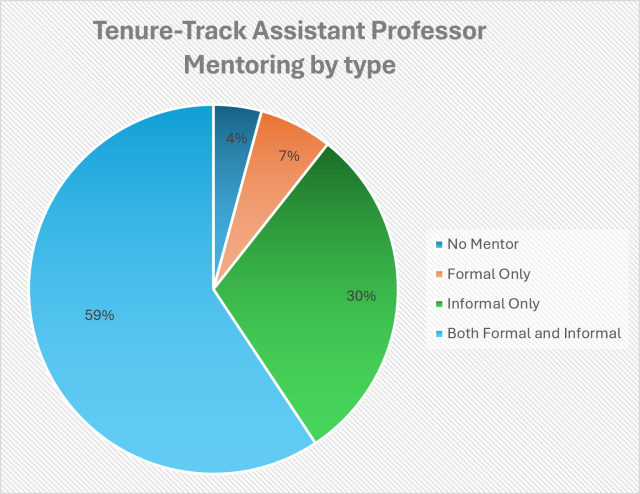
Pie Chart showing tenure- track Assistant Professor Mentoring Types with 59% Both Formal and Informal, 30% Informal Only, 7% Formal, and 4% No Mentor.
* Formal mentoring is in TIU only.
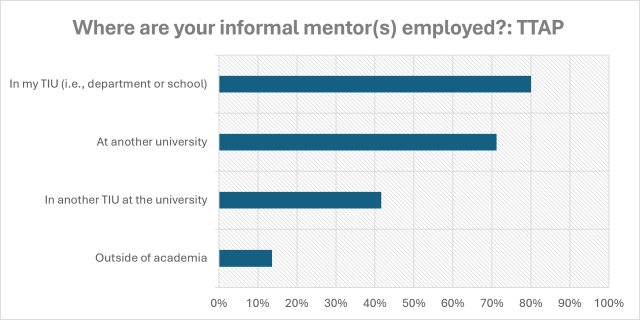
Horizontal bar chart showing where Tenure-Track Associate Faculty mentors are employed. With approximately 80% in in their TIU, 72% at another university, 43% in another TIU at their university, and 15% outside of academia.
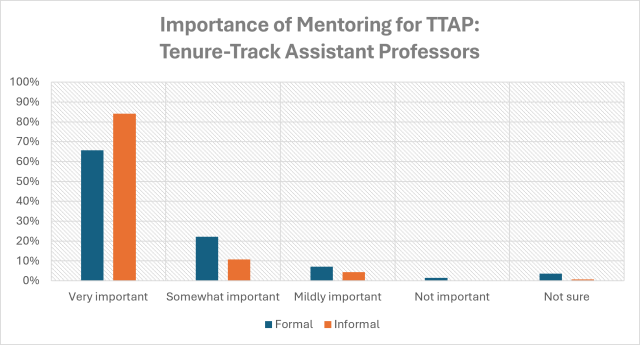
Vertical bar chart showing the importance of Mentoring for TTAP: Tenure-Track Assistant Professors. The chart shows a comparison between formal and informal responses: Approximately 65% formal and 83% informal very important, 22% formal and 10% informal somewhat important.
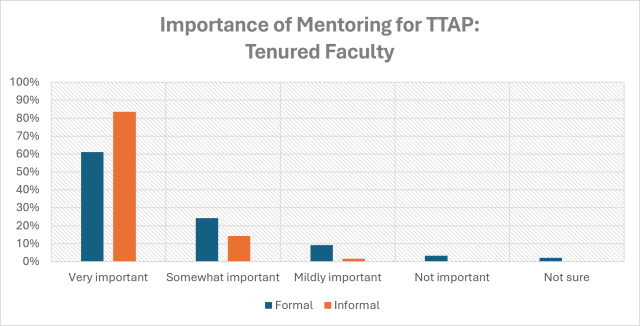
Vertical bar chart showing the importance of Mentoring for TTAP: Tenured Faculty. The chart shows a comparison between formal and informal responses: similar results are found as with tenure-track assistant professors. Tenured faculty includes tenured associate professors and tenured professors.
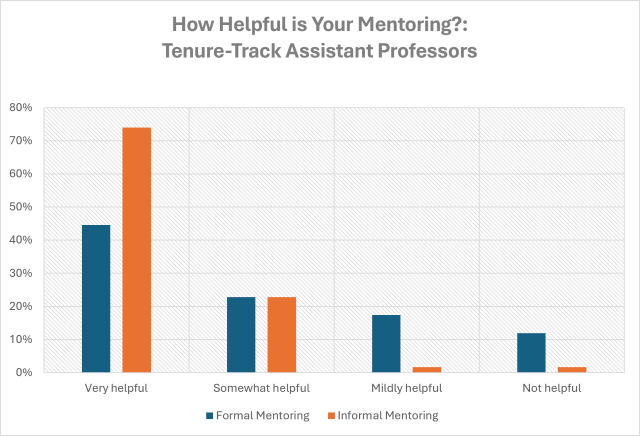
Vertical bar chart showing the How Helpful is Your Mentoring?: Tenure-Track Assistant Professors. The chart shows a comparison between formal and informal responses: Approximately 45% formal and 74% informal very important, 22% formal and 22% informant somewhat important, 18% formal and 3% informal mildly important.
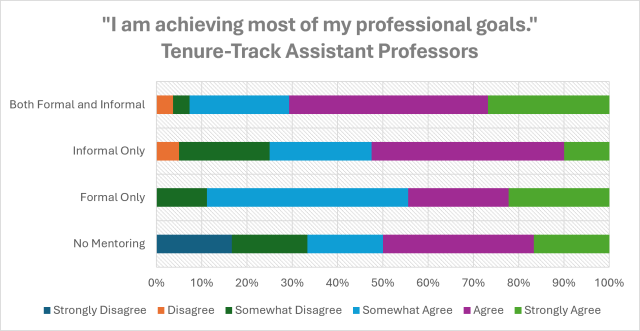
Horizontal chart showing responses for "I am achieving most of my professional goals." Tenure-Track Assistant Professors comparing informal and formal mentoring, informal only, formal only, and no mentoring with a 30-80% ratio agreeing with both informal and formal, a slightly higher ratio for informal only, and a slightly lower ratio for formal only.
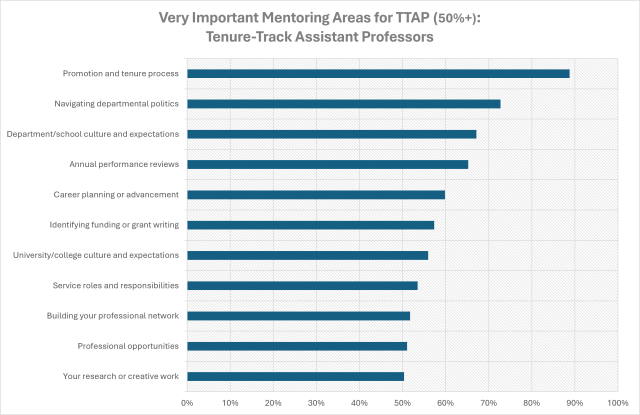
Horizontal bar chart in blue showing Very Important Mentoring Areas for TTAP (50%+): Tenure-Track Assistant Professors. The chart shows Promotion and tenure as the highest valued at approximately 88% followed in order with decrease values by Navigating department politics, department and school expectations, annual performance reviews, career planning or advancement, identifying funding or grant writing, and university /college expectations. Other areas are shown with a standard response average of around 50%.
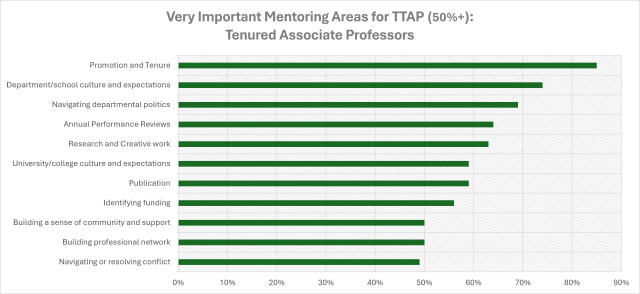
Horizontal bar chart in green showing Very Important Mentoring Areas for TTAP (50%+): Tenured Assistant Professors. The chart shows Promotion and tenure as the highest valued at approximately 85% followed in order with decrease values by department and school expectations, navigating department politics, annual performance reviews, research and creative work, university /college expectations, publications, and identifying funding. Other areas are shown with a standard response average of around 50%.
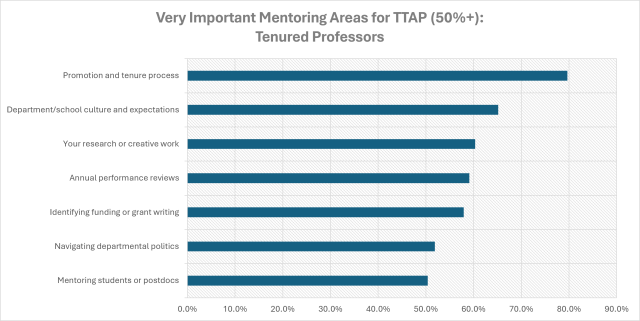
Horizontal bar chart in green showing "Very Important Mentoring Areas for TTAP (50%+): Professors". The chart shows Promotion and tenure as the highest valued at approximately 79% followed in order with decrease values by department and school expectations, research and creative work, annual performance reviews, identifying funding or grant writing, navigating department politics, and mentoring students or postdocs.
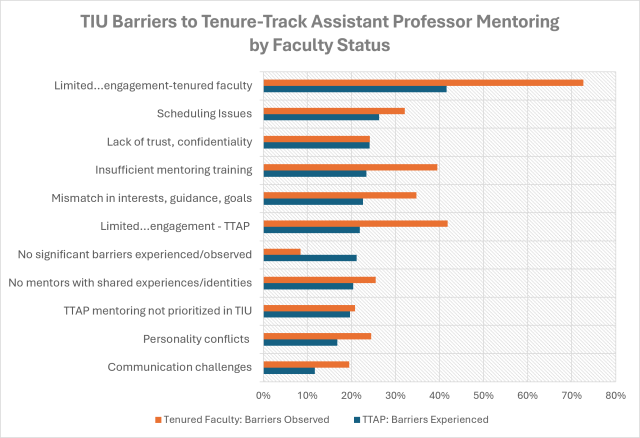
Horizontal bar chart comparing tenured faculty and tenure-track associate faculty across 11 areas with Limited engagement-tenured faculty ranking the highest for both groups followed in an averaged decreasing value by scheduling issues, lack of trust, insufficient mentoring training, mismatched interest, limited engagement tenure track faculty, no significant barriers, no mentors with shared experiences, TTAP mentoring no a priority in TIU, personality conflicts, and communication challenges.
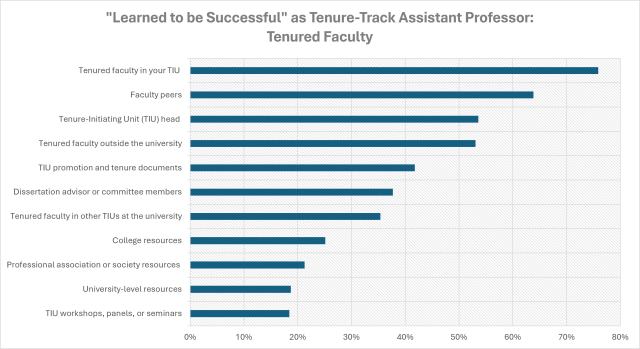
Horizontal bar chart showing responses for how one "Learned to be successful". Tenured faculty in TIU ranked the highest with approximately 85% followed by a steady average bell decrease with faculty peers, TIU head, tenured faculty outside the university, TIU promotion and tenure documents, dissertation advisor or committee members, tenured faculty in other TIUs at the university, college resources, professional association or society resources, university level resources, and TIU workshops.
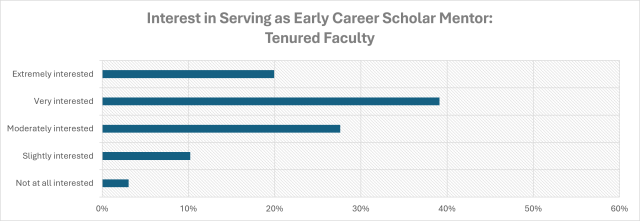
Horizontal bar chart in blue showing responses from tenured faculty about their interest in serving as early career scholar mentors. Extremely interested 20%, very interested 38%, moderately interested 27%, slightly interested 11%, not interested 4%.
Tenured Associate Professor (TAP) Mentoring
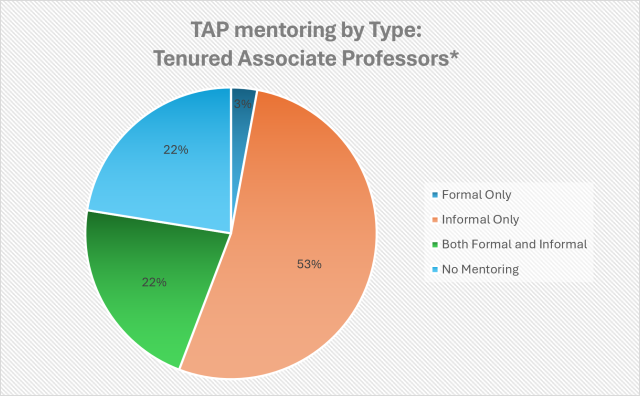
Pie Chart showing Tenured Associate Professor Mentoring Types with 22% Both Formal and Informal, 33% Informal Only, 22% Formal, and 3% No Mentor.
*Formal mentoring is in TIU only.
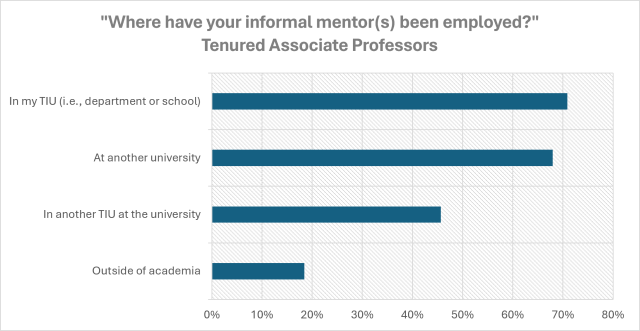
Horizontal bar chart showing where Tenured Associate Faculty mentors are employed. With approximately 72% in their TIU, 68% at another university, 45% in another TIU at their university, and 18% outside of academia.
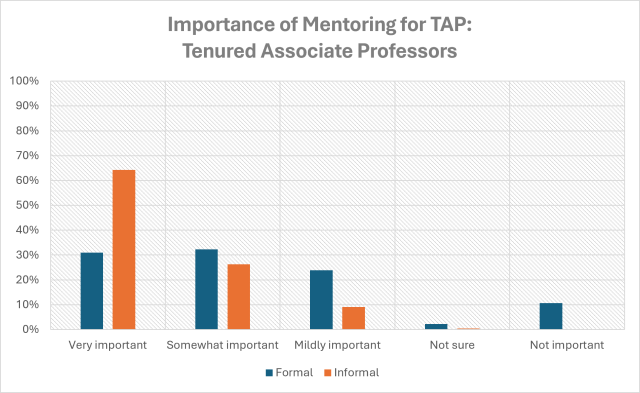
Vertical bar chart showing the importance of Mentoring for TTAP: Tenured Associate Professors. The chart shows a comparison between formal and informal responses: Approximately 31% formal and 64% informal very important, 32% formal and 27% informal somewhat important.
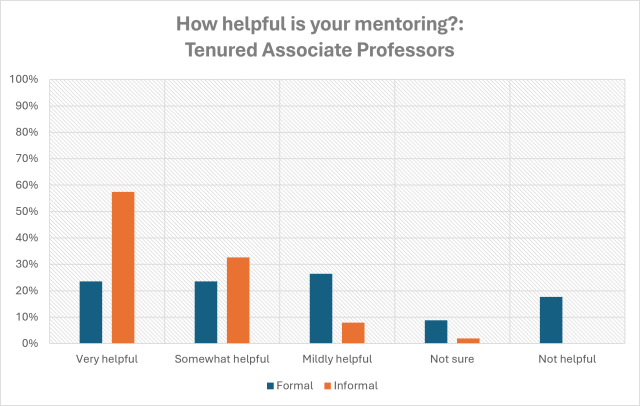
Vertical bar chart showing the How Helpful is Your Mentoring?:
Tenured Associate Professors. The chart shows a comparison between formal and informal responses: Approximately 23% formal and 58% informal very important, 23% formal and 32% informant somewhat important, 18% formal and 8% informal mildly important.
Tenured Associate Professors. The chart shows a comparison between formal and informal responses: Approximately 23% formal and 58% informal very important, 23% formal and 32% informant somewhat important, 18% formal and 8% informal mildly important.
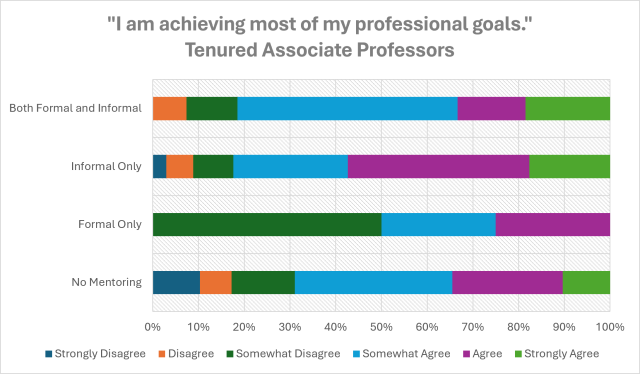
Horizontal chart showing responses for "I am achieving most of my professional goals." Tenured Associate Professors comparing informal and formal mentoring, informal only, formal only, and no mentoring with a 18-65% ratio somewhat agreeing with both informal and formal, a slightly lower ratio for informal only, and a slightly higher ratio for formal only.
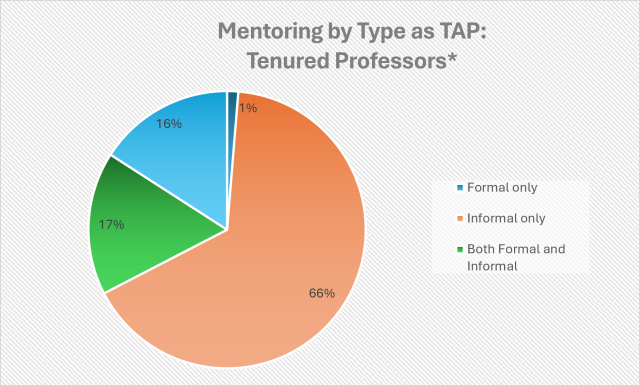
Pie Chart showing Tenured Professor Mentoring Types with 17% Both Formal and Informal, 66% Informal Only, 16% Formal, and 1% No Mentor.
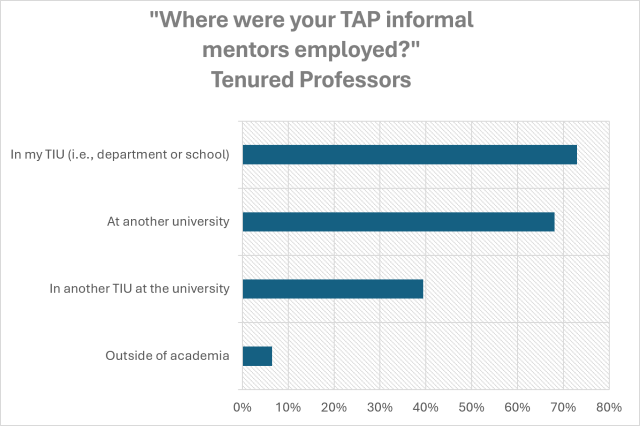
Horizontal bar chart showing where Tenured Professor mentors are employed. With approximately 73% in in their TIU, 68% at another university, 49% in another TIU at their university, and 6% outside of academia.
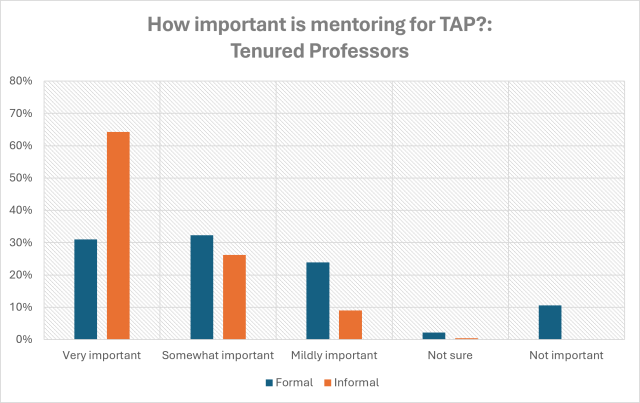
Vertical bar chart showing the importance of Mentoring for TAP: Tenured Professors. The chart shows a comparison between formal and informal responses: Approximately 31% formal and 64% informal very important, 32% formal and 27% informal somewhat important.
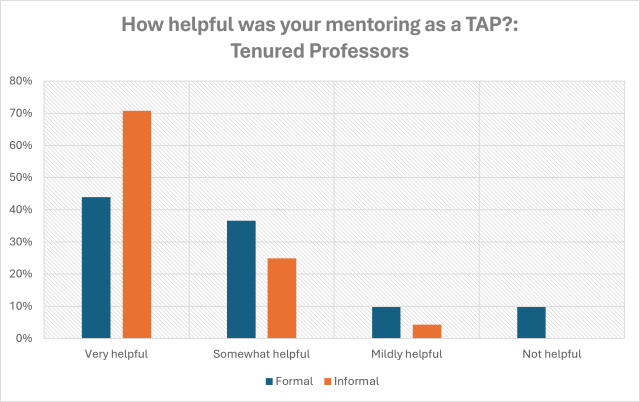
Vertical bar chart showing the How Helpful is Your Mentoring?: Tenured Professors. The chart shows a comparison between formal and informal responses: Approximately 44% formal and 71% informal very important, 37% formal and 24% informant somewhat important, 10% formal and 4% informal mildly important.
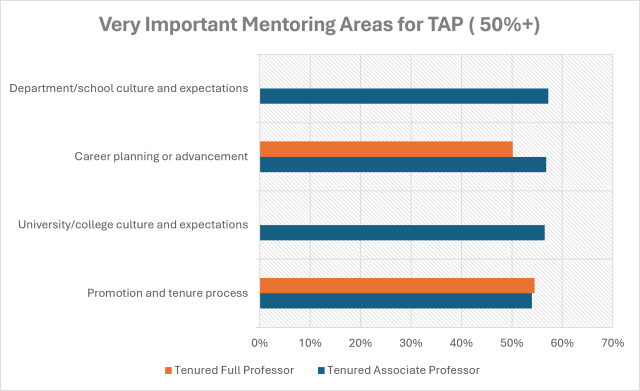
Horizontal bar chart comparing tenured full professor (TP) and tenured associate professor (TAP) across 4 categories of importance for areas of mentoring: Department or school culture TAP 57% no answers for TP, Career planning TAP 67% and TP 50%, University culture 66% for TAP, no response on TP, Promotion and tenure 54% TAP and 55% TP.
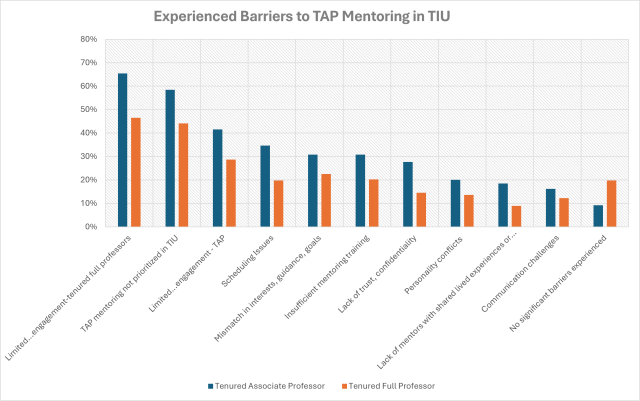
Vertical bar chart comparing tenured full professor and tenured associate faculty across 11 areas with Limited engagement-tenured full professor ranking the highest for both groups followed in an averaged decreasing value by TAP mentoring not a priority in TIU, limited engagement tenure track associate professor, scheduling issues, mismatched interest, insufficient mentoring training, lack of trust, personality conflicts, no mentors with shared experiences, communication challenges, and no significant barriers.
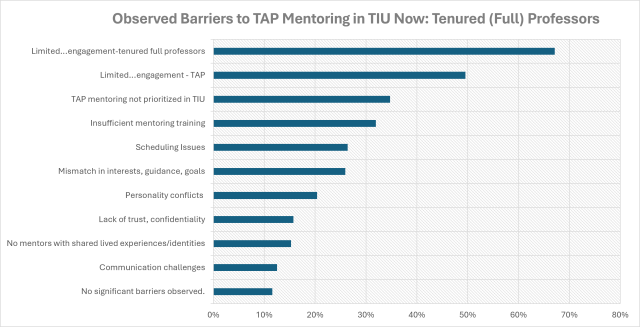
Horizontal bar chart showing responses from tenured full professor about observed barriers to TAP Mentoring in TIU across 11 areas with Limited engagement-tenured full professor ranking the highest for both groups followed in an averaged decreasing value by limited engagement tenure track associate professor, TAP mentoring not a priority in TIU, insufficient mentoring training, scheduling issues, mismatched interest, personality conflicts, lack of trust, no mentors with shared experiences, communication challenges and no significant barriers.
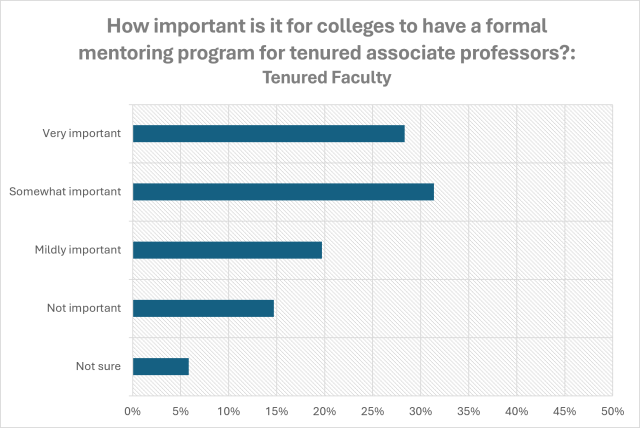
Horizontal bar chart in blue showing responses from tenured faculty about importance of colleges formal mentoring program for TAP. Approximate values are: Very important 27%, somewhat important 32%, mildly important 19%, not important 14%, not sure 7%.
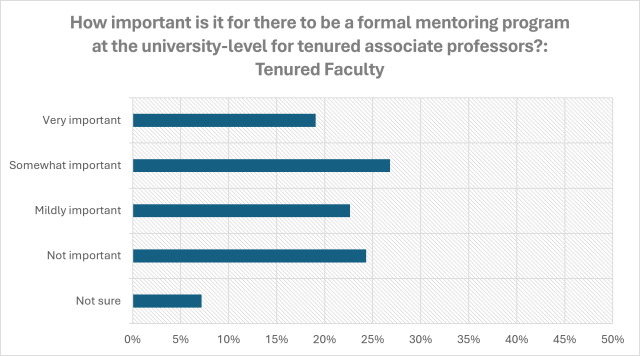
Horizontal bar chart in blue showing responses from tenured faculty about importance of university level formal mentoring program for TAP. Approximate values are: Very important 18%, somewhat important 27%, mildly important 23%, not important 28%, not sure 8%.
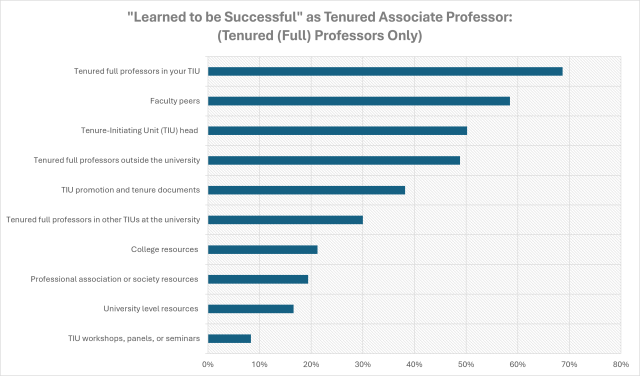
Horizontal bar chart showing responses for how one "Learned to be successful" for tenured full professors only. Tenured full professor in TIU ranked the highest with approximately 69% followed by a steady average bell decrease with faculty peers, TIU head, tenured full professor outside the university, TIU promotion and tenure documents, tenured full professor in other TIUs at the university, college resources, professional association or society resources, university level resources, and TIU workshops.
Tenured Professor Mentoring
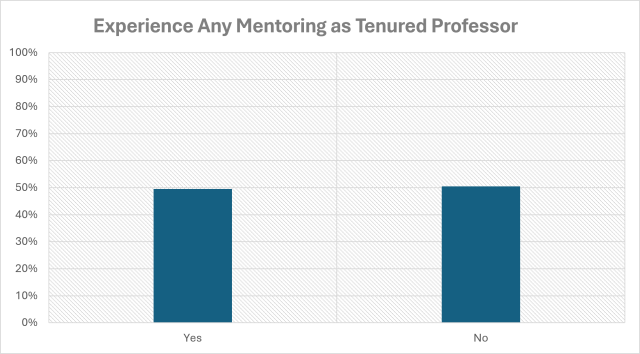
Vertical bar chart showing responses from Tenured Professor about experience with any mentoring as a tenured professor. Approximately 50% yes, 50% no.
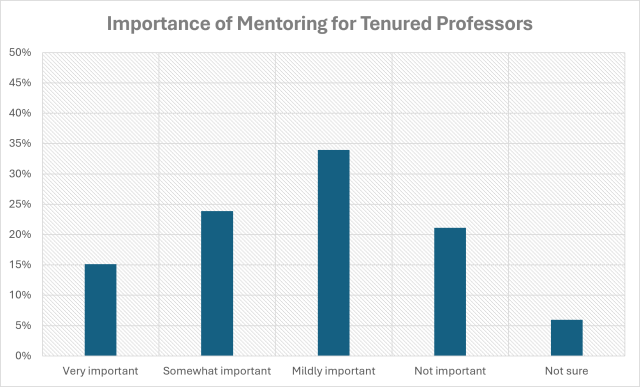
Vertical bar chart showing responses of tenured professor for importance on mentoring. Approximate values are: Very important 15%, somewhat important 24%, mildly important 34%, not important 22%, not sure 6%.
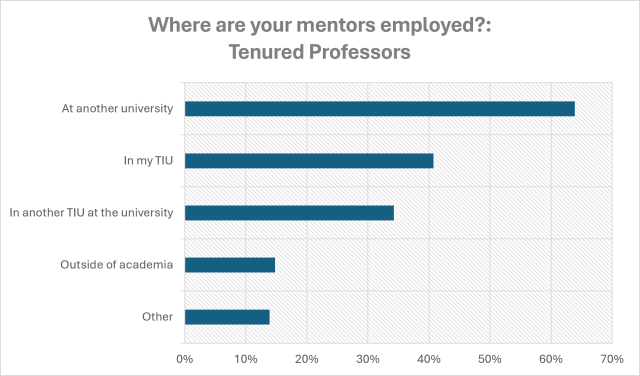
Horizontal bar chart showing responses of tenured faculty about where their mentors were employed.With approximately 64% at another university, 42% in their TIU, 35% in another TIU at their university, and 15% outside of academia, 14% other.
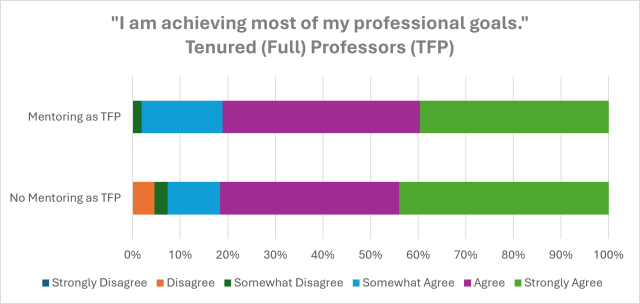
Horizontal chart showing responses for "I am achieving most of my professional goals." Tenured Full Professors comparing mentoring as TFP and no mentoring as TFP: Mentoring as TFP has similar result of strongly agree and agree and smaller amounts as somewhat agree and somewhat disagree while no mentoring has a slightly large amount as strongly agree, less a agree, and smaller amounts in the disagree categories.
Endnotes
- Microsoft Copilot was utilized to correct and improve grammar in this report and, in some areas, assist with synthesizing text. Microsoft Copilot served as a supplementary tool for qualitative analysis. Microsoft Copilot provided limited actionable insights on coding for quantitative analysis at this stage of analysis.
- I am profoundly grateful to Maritza Pierre, who served as the Graduate Student Assistant for these efforts. Her partnership and collaboration were instrumental throughout the faculty mentoring study. Maritza contributed with exceptional skill and dedication, conducting content analyses, literature reviews, and qualitative analyses that significantly strengthened the quality and depth of this work. Her efforts tremendously contributed to the success of this project.
- Our primary analytic approach for the qualitative data involved employing a combination of reading and organizing qualitative data manually to initially identify patterns and develop codes. Then, the codes were created in a qualitative software program and used to organize patterns and themes in the data. Additionally, statistical descriptive analysis was conducted primarily in Qualtrics, with minimal use of Stata as well. Charts and tables were created in Excel.
- It was a wonderful experience to hear the thoughts, perspectives, and experiences of my colleagues across Ohio State’s peer institutions, as well as our college leadership, department heads, and school directors. Your insights were invaluable and will play an important role in shaping faculty mentoring at Ohio State. I cannot thank you enough for the time and expertise you so generously shared.
- The official university label is “tenured professor,” and in practice, both “tenured professor” and “tenured full professor” are used interchangeably to indicate the same rank.
- I am deeply grateful to my colleagues—Anika Anthony, Reanne Frank, Michele Hansen, Kaprea Johnson, Tom Magliery, Helen Malone, David Melamed, Mohammed Rahman, Shari Speer, and Andrea Williams—for their thoughtful input and feedback on the faculty mentoring surveys. A special thank you to Jamilah Hackworth (University of Cincinnati), Kaprea Johnson, and Helen Malone for providing specific feedback on this report. The insights and input of my colleagues were invaluable in shaping this work. I also extend my sincere appreciation to the many colleagues across Ohio State who generously took the time to participate in the study. Your participation and perspectives have been instrumental in advancing our understanding of faculty mentoring at the university.