Office of Academic Affairs

Ohio State University Faculty Mentoring Report, Recommendations And Guidelines

Executive Summary

Introduction

Higher education drives societal progress by generating new knowledge, fostering innovation, and supporting the people who make that work possible. At the center of this mission is faculty mentoring—a critical driver of faculty success, retention, collaboration, and institutional excellence. Strengthening mentoring is essential to sustaining Ohio State’s academic vitality and ensuring an environment where all faculty can thrive.

To advance this priority, the university launched an initiative to create an evidence based, university wide mentoring framework grounded in faculty experiences and informed by national best practices. The 2025 Study on Faculty Mentoring, spearheaded by Korie Little, used a multi method approach—surveys, interviews, focus groups, and benchmarking against 21 Big Ten and other peer institutions—to examine how mentoring is experienced, supported, and valued across roles, ranks, appointment types, colleges, and regional campuses. Close to 650 faculty participated, along with deans, associate deans, department chairs, school directors, and senior administrators. Together, these efforts provide a clear, comprehensive picture of faculty mentoring at Ohio State—one shaped by faculty voices, academic leadership, and lessons from peer institutions. What emerged is a strong sense of the university’s existing assets and the opportunities ahead, which informed a university framework for faculty mentoring. This framework positions Ohio State to implement mentoring structures that are more intentional, more supportive, and more aligned with faculty needs. The key findings below reflect consistent themes across units and groups.

Key findings

  • TIUs are the cornerstone of faculty mentoring. They are the primary and most effective sites of mentoring support.
  • Informal mentoring is highly valued. Trusting, organic relationships are among the most meaningful and impactful forms of mentoring.
  • Mentoring practices are uneven. Units vary widely in how mentoring is defined, structured, and communicated.
  • Early career faculty benefit from structure. Clear guidance and formal programs, paired with informal support, are valuable for new faculty success.
  • Mid career faculty have unmet needs. Mid career faculty need more intentional mentoring for promotion to professor and clearer role expectations.
  • Tenured professors need mentoring too. Key areas include leadership development, career planning, expanding research impact, and securing major projects and grants.
  • Equity matters. Mentoring experiences vary across appointment types, identities, and disciplines, highlighting opportunities to promote greater consistency and access.

Guiding principles

The framework is built on principles informed by the study and peer institution review. Foundationally, mentoring at Ohio State is strengthened by shared responsibility and aligned purpose. TIUs serve as local catalysts for mentoring and professional growth, colleges champion and reinforce these efforts, and Academic Affairs provides the unifying vision and expectations. Faculty are empowered to lead their own mentoring journeys, supported by clear and consistent messaging that sustains a strong mentoring culture. Effective mentoring is grounded in collaboration, reciprocity, and mutuality, while remaining flexible enough to reflect the unique needs and cultures of individual units. Both formal and informal mentoring play essential roles in faculty success. Affirming the diverse identities, needs, and mentoring styles of faculty ensures that everyone can thrive, and celebrating mentoring as essential professional labor reinforces its value and encourages continued engagement across the university.

Mentoring roles across the university

  • Provost’s Office: Advances the university’s mission through a unifying mentoring vision that honors the work of TIUs, colleges, and regional campuses while supporting flexible, aligned practices that expand opportunities and elevate mentoring as essential to faculty success.
  • Colleges and Regional Campuses: Reinforce TIU efforts, expand formal and informal mentoring opportunities, support faculty at key career stages, and celebrate mentoring as vital professional labor.
  • Departments/Schools (TIUs): As the foundation of faculty mentoring, cultivate flexible, inclusive formal and informal support that empowers faculty and strengthens a collaborative, growth focused culture.
  • Individual Faculty: Empowered to actively shape their own mentoring relationships and contribute to a culture of collegiality, reciprocity, and mutual support.

What the framework achieves

When mentoring is embraced and supported, faculty thrive, units are strengthened, and the university’s academic mission is advanced. This framework provides Ohio State with a coherent, evidence based foundation for strengthening faculty mentoring. It clarifies expectations, elevates the contributions of TIUs, colleges, and regional campuses, and supports a culture where mentoring is recognized as a shared responsibility and a cornerstone of academic excellence. It offers alignment and guidance while honoring the diverse cultures and disciplinary contexts of units across the university. 


Prepared by Korie Little

Office of Faculty Affairs Faculty Fellow

University Distinguished Scholar and Professor, Department of Sociology

May 2026


Advancing the future of faculty mentoring at Ohio State

Higher education is critical to societal progress—a space where bold ideas take shape, innovation flourishes without boundaries, and faculty collaborate to advance the frontiers of knowledge. At the heart of this mission lies a critical yet often underappreciated element: faculty mentoring. Effective mentoring not only supports individual career development but also strengthens the academic ecosystem, fostering collaboration, retention, and long-term institutional success. Recognizing this, The Ohio State University has made faculty mentoring a strategic priority.

Faculty mentoring at Ohio State aspires to cultivate transformative connections, encourage shared expertise, and empower faculty at every career stage. By investing in mentoring, Ohio State affirms its commitment to creating an environment where faculty thrive—where professional growth is supported, scholarly impact is advanced, and the university’s mission of excellence is realized.

Previous work on Ohio State mentoring

In 2021, three Ohio State faculty members—Philip F. Binkley, James W. Overstreet, and Carole Anderson—developed a report titled “The State of Mentoring at The Ohio State University: A Preliminary Report and Recommendations for Its Advancement.” This report examined the state of mentoring at Ohio State and outlined steps to build a culture of intentional and inclusive mentorship. Their findings were informed by surveys of Associate Deans, faculty listening groups, discussions with the President and Provost’s Council on Women, and a review of the National Academies report on mentorship. The report reveals that while some colleges have structured programs, access and consistency vary widely. Faculty emphasized that mentoring is essential for career success, trust-building, and creating supportive academic environments. Barriers include limited time, formal training, and uneven access for underrepresented faculty.

To address these gaps, the report recommended adopting a clear university-wide definition of mentorship and developing best-practice guidelines for departments. It called for mentoring to be recognized as a core expectation in promotion and tenure, with success measured by mentee outcomes rather than numbers alone. Expanding mentor training—both online and in person—is critical, with an emphasis on culturally responsive practices and early-career preparation. Departments and schools should implement structured feedback systems to monitor effectiveness and address negative experiences proactively. The report also encouraged diverse mentoring models, including peer and cross-disciplinary approaches, and the use of tools like mentoring compacts and individual development plans. Finally, it recommended creating a central resource or council to coordinate efforts, share expertise, and foster collaboration, as well as advancing research on mentoring effectiveness and best practices.

Building on this foundation, this current work aims to continue cultivating a strong culture and community around faculty mentoring at Ohio State. In preparation of this effort, a comprehensive, multi-method study was conducted to understand existing mentoring models and practices. Specifically, this study sought to understand university-wide faculty mentoring programs, explore mentoring activities across Ohio State’s colleges and campuses, and gather perspectives from department and school leaders. Most importantly, it sought to understand faculty experiences and viewpoints.

Before that, an extensive literature review on faculty mentoring was conducted.

Literature summary on faculty mentoring

What is faculty mentoring and why it matters

Faculty mentoring is about supporting both the career and personal well-being of faculty members (Ivey & Dupré, 2020). More commonly, it is seen as a relationship where an early-career faculty member receives guidance, sponsorship, or protection from a more experienced colleague (Sands et al., 1991). Traditionally, mentoring has been seen as a step-by-step process. Kram (1983) describes four stages: initiation (building rapport), cultivation (mutual investment), separation (relationship shifts or declines), and redefinition (ending or transforming the relationship). Today, mentoring is often more flexible and reciprocal, focusing on partnership and co-learning (Dominguez & Kochan, 2020). Models have also expanded to include group and peer mentoring, which encourage collaboration and shared accountability (Mullen & Klimaitis, 2019).

Mentoring benefits both faculty and institutions. For faculty, it can mean clearer tenure and promotion expectations, skill development, better retention, and overall faculty well-being (Ramalho, 2011; Tran & Gibson, 2016; Giacumo et al., 2020; Mazerolle et al., 2018). Mentored faculty often report higher job satisfaction, faster salary growth, and quicker promotions compared to those without mentors (Baran & Zarzycki, 2021). Good mentoring also provides emotional support and informal feedback that reduce stress and improve retention (Tran & Gibson, 2016; Savage et al., 2004).

Institutions benefit too—mentoring helps with onboarding, boosts motivation, and lowers turnover costs (Dunham-Taylor et al., 2008; Mazerolle et al., 2018). It also strengthens professional networks by promoting knowledge sharing and collaboration across departments (Giacumo et al., 2020; Wikström et al., 2023). Involving emeriti faculty adds even more value, leveraging their expertise while supporting diversity efforts (Mendez et al., 2019). Overall, research consistently shows that mentoring improves retention, job satisfaction, scholarly productivity, and institutional growth (Houston, 2019; Wasserstein et al., 2007).

Faculty mentoring models

Mentoring programs vary in structure and goals:

  • Formal mentoring: Institution-supported relationships with clear expectations and timelines. These programs improve productivity, speed up promotions, and help faculty integrate socially (Lumpkin, 2011; Morrison et al., 2014; Jackevicius et al., 2014). Matching mentors and mentees based on expertise and needs boosts satisfaction (Ullrich et al., 2020). Even long-distance mentoring works with good planning (Owens et al., 1998).
  • Informal mentoring: Unstructured, relationship-driven, and often based on shared interests. It can offer deeper emotional support, especially for underrepresented faculty (Booker, 2025; Leslie et al., 2005). However, it is less consistent and may not meet all professional development needs (Leslie et al., 2005).
  • Hybrid models: Peer and team mentoring combine structure with flexibility. Peer mentoring reduces isolation and builds community (Lumpkin, 2011; Shah, 2024), while team mentoring provides broader expertise and reduces risks of poor matches (Gray & Birch, 2007). Learning communities and network-based models promote collaboration and institutional integration (Meyer, 2002; Scutelnicu, 2023). Research-focused programs boost publication rates and confidence (Jackevicius et al., 2014).

Mentoring culture and program design 

A strong mentoring culture is essential for faculty success and institutional growth. It requires leadership support, formal infrastructure, and accessible resources (Sheridan et al., 2015; Welch et al., 2012). Structured programs are especially important for new and early-career faculty, who often lack access to effective mentoring (Chew et al., 2003). Orientation and mentoring initiatives promote collegiality, clarify expectations, and ease the tenure process (Keating, 1996). Peer networks and mentoring committees provide diverse feedback and foster belonging (Murray et al., 2024). Mid-career and non-tenure-track faculty also benefit, highlighting the need for inclusive, adaptable programs (Buch et al., 2011; Munro-Stasiuk et al., 2019; St. Clair, 1994).

Mentoring programs work best when they are intentionally designed, well-supported, and adaptable. Strong programs include structured mentor-mentee matching, transparent processes, and ongoing feedback (Eisner, 2015; Bryant et al., 2015; Dawson, 2014; Karcher et al., 2006). Flexibility and inclusivity are essential—virtual and peer mentoring options can help reduce isolation and increase engagement (Faber et al., 2017; Schulte et al., 2022). Institutional backing, mentor training, and diversity-focused strategies further improve outcomes (Nick et al., 2012; Desselle et al., 2021; Fountain & Newcomer, 2016; Rodriguez-Arroyo et al., 2025).

Assessment is equally important. Programs should use clear benchmarks, structured evaluation tools, and consistent oversight. Unstructured or voluntary approaches can lead to uneven access and limited impact (Al-Jewair et al., 2019). Standardized instruments can measure relationship quality (Berk et al., 2005), while rigorous evaluation methods ensure both processes and outcomes are captured (Gilbreath et al., 2008). Regular assessment should be built into program design from the start (Lumpkin, 2011).

Equity, relationship quality and training

Mentoring should address challenges faced by women, ethnic minorities, and foreign-born faculty (Waxman et al., 2009; Lunsford et al., 2018; Coker & Rothblum, 2024). It is increasingly seen as a way to tackle inequities, foster belonging, and challenge traditional structures (Graham, 2019; Gibson, 2006; Goerisch et al., 2019; Estrada et al., 2018). Especially in these contexts, relational frameworks that promote mutual growth and non-hierarchical structures are recommended (Lewis & Olshansky, 2016), and peer mentoring circles can advance inclusion and institutional change (Thomas et al., 2015).

Moreover, the quality of the relationship is essential. Several interpersonal qualities and structured tools can strengthen it. Effective mentoring depends on mutual engagement, clearly defined roles, and thoughtful matching (Bell & Treleaven, 2011). Chemistry between mentor and mentee helps (Jackson et al., 2003), as do clear expectations, proactive communication, and shared responsibility (Marino & Yost, 1998; Zerzan et al., 2009). Good mentors are accessible, collaborative, emotionally intelligent, culturally sensitive, and supportive; mentees should take an active role and seek diverse mentors (Johnson, 2003; Gandhi & Johnson, 2016; Cheng & Hackworth, 2021; Perry & Parikh, 2018). Mentor training is vital to making mentorship a skill that can be learned and made assessable (Johnson, 2003).

Key Takeaways: Literature Overview

Faculty mentoring is a multifaceted process that supports career development, psychosocial well-being, and institutional success. Effective mentoring—whether formal, informal, or through hybrid models—enhances faculty retention, satisfaction, scholarly productivity, and collegiality. Best practices emphasize structured programs with clear expectations, mentor training, flexibility for local adaptation, and inclusive approaches that address the needs of underrepresented groups. Sustaining a strong mentoring culture requires institutional commitment, recognition of mentoring contributions, resource provision, and ongoing assessment to ensure responsiveness and impact.


The literature on faculty mentoring is extensive, and the key insights highlighted above offer a strong foundation. What we learned from this scholarship directly shaped the design of the 2025 faculty mentoring study at Ohio State. The next section outlines how that study was conducted and highlights central findings.
 

Introduction

The 2025 Study on Faculty Mentoring set out to illuminate how mentoring truly lives across Ohio State—how it is experienced, supported, and valued in the day to day work of faculty. With the aim of building a university wide framework that is both comprehensive and responsive, the study sought to understand the full ecosystem of mentoring, from formal structures to the informal practices that shape faculty life. Because mentoring is deeply tied to faculty success, well being, and long term retention, we looked to peer institutions and to our own community, weaving together broad insights with Ohio State’s unique context. Through a multi method design that engaged administrators, department and school leaders, and faculty across ranks and appointment types, the study generated a rich, layered picture of mentoring at the university. What follows is an overview of how the study was conducted and the central findings that emerged.

2025 Study on Faculty Mentoring: Research Methodology and Design

A multi-method study on faculty mentoring designed and spearheaded by Korie Little (University Distinguished Scholar and Professor, Department of Sociology; Office of Faculty Affairs Faculty Fellow) with the support of Maritza Pierre (then PhD candidate, CFAES School of Environment and Natural Resources) was conducted in 2025. The goal was to develop a nuanced yet comprehensive understanding of mentoring values, experiences, and practices that shape faculty success. To achieve this, a wide range of resources and approaches were employed. 

A review of 21 university-wide faculty mentoring programs across Big Ten institutions and other peer universities recognized for strong mentoring initiatives (see Appendix A for list) was conducted. This review included analyzing Office of Faculty Affairs websites—or those of equivalent offices responsible for mentoring—for evidence of system-level mentoring assignments, structured activities, and university-level policies supporting faculty-to-faculty mentoring. Where such indicators were present, we performed deeper content analysis to understand program design, implementation strategies, and sustainability. To complement this review, vice provosts and senior administrators from six peer institutions with robust mentoring programs were interviewed. Another was done with a tenured professor now at Ohio State about the faculty mentoring programs of his former employer. These conversations examined how initiatives were launched, how they function in practice, and what has been learned over time—offering models and high level insights on faculty mentoring. While much was learned from our peer institutions, the heart of the study is Ohio State. Deans and associate deans of faculty affairs from fourteen colleges and three regional campuses were interviewed, exploring what works well, where challenges persist, and their ideas for strengthening university-wide support at Ohio State. College and campus websites were also reviewed to help map current mentoring practices. 
To capture department-level perspectives, we invited all department chairs and school directors to participate in a focus group—Eighteen TIU heads total participated in two focus groups, one in-person and one virtual. These candid discussions addressed their goals for mentoring, effective implementation, and areas of success and growth, among other areas.

Finally, faculty were engaged. Two IRB-approved surveys were fielded to all tenure-line faculty across Ohio State’s colleges and campuses: one for tenure-track assistant professors and one for tenured faculty. These surveys aimed to: (i) identify ways the university can support existing mentoring efforts and (ii) understand faculty perspectives and experiences. We received 149 responses from assistant professors and 474 from tenured faculty, totaling 623 participants—providing a rich dataset for analysis. Six virtual focus groups were conducted with Clinical, Teaching, Practice, (CTP) faculty, involving a total of 26 participants. All CTP faculty were invited to participate in these sessions, which provided an opportunity for them to share experiences, perspectives, and recommendations related to faculty mentoring.

Together, these efforts created a clear and well-rounded picture of faculty mentoring at Ohio State—one shaped by the voices of faculty, the insights of academic leaders, and lessons drawn from peer institutions. What emerged is a clear sense of both the strengths we can build on and the opportunities ahead. This collective knowledge now positions the university to design mentoring structures that are more intentional, more supportive, and more aligned with the needs of our faculty. The findings that follow capture the most consistent themes that surfaced across this work and point the way toward a stronger, more integrated mentoring culture at Ohio State.

Findings summary

Big Ten (Plus) University-Wide Faculty Mentoring Programs: What We Learned?

A review of the university faculty mentoring initiatives of peer institutions revealed significant variation in program development. Some institutions offer a diversity of advanced, well-developed mentoring activities and comprehensive programs, others provide basic mentoring guidelines and policies, and others fall anywhere between these approaches. Moreover, programs range in how long they have been established, from being in place for over a decade to those launched within the last few years. While many emphasize voluntary and flexible approaches, others institutionalize expectations through formal agreements, mentoring plans, and structured guidelines. 

In short, there is no one-size-fits-all solution. Successful programs fit the mission and vision and culture of their institutions; they ensure flexibility, secure faculty buy-in and provide clear expectations and resources. They balance adaptability with institutional support, embedding mentoring into the culture while remaining open to change and improvement.

University Mentoring Goals 

One key lesson from peer institutions is the importance of clarity around the goals of faculty mentoring within the university. These goals should be clearly defined, customized to align with the institution’s culture, and formally documented within its structure and policies.

The mentoring goals of the universities we reviewed vary, but several common themes emerge. Public-facing statements emphasize supporting faculty in achieving their goals and succeeding in their work, while promoting collaboration, personal growth, skill development, and career progression. Many universities highlight the importance of fostering a culture of mentoring and inclusion, recognizing and rewarding effective mentoring, and ensuring that mentoring practices enhance research quality. Conversations with administrative leaders reinforced that retention and community-building are top priorities, alongside helping faculty feel embedded and well-networked across departments and colleges. 

University-Level Mentoring Approaches

Many universities view mentoring as part of a larger faculty development ecosystem. The programs at times are integrated with professional development centers and diversity initiatives. In addition to programming for tenure-line faculty, there are initiatives that target department chairs and instructional-, clinical-, and research-track faculty, ensuring that mentoring meets diverse needs across the academic spectrum.

While mentoring approaches vary widely, common formats include traditional one-on-one mentoring and mentoring pods. Peer mentoring and learning circles are also popular. They are often organized around specific goals—such as research interests or professional development—or around shared identities, like women leaders or faculty of color. Universities offer a range of activities tailored to different career stages, including orientations and meetings or workshops for new faculty. There is also an emphasis on “mid-career institutes” that support faculty who are well into the tenure process or recently tenured. Additionally, cohort-based models are common, especially for early- and mid-career faculty, with semester- or year-long programs requiring regular attendance. Another key distinction in mentoring approaches lies in their focus. One approach emphasizes sharing knowledge and leveraging the expertise of mentors. The other prioritizes empowering faculty by equipping them with the skills and strategies needed to build a customized, diverse network of mentors aligned with their individual goals and needs. 

Two faculty mentoring initiatives stand out in our review as exemplary models for their comprehensiveness and depth and emphasis on mission and vison for faculty and the institution. One is Northwestern University’s Provost’s Small Group Mentoring Program. This is an extended program that employs a mentoring pods modal to support the development and advancement of tenure-track assistant professors. The other is Georgia Tech University’s 2½-day off-site retreat for recently tenured faculty, designed to help participants reflect on the value of tenure, consider evolving roles, establish norms and expectations for tenured faculty, and explore new directions for research, risk-taking, and leadership.

Support, Affirmation, and Celebration

It is essential to support, affirm, and celebrate faculty mentoring at the university level. This commitment is demonstrated in several ways, beginning with incentives. Many peer institutions allocate financial resources to faculty mentoring efforts. This includes stipends for mentors participating in university organized mentoring programs that span a semester or more. Others offer grants for faculty interested in developing extended peer mentoring pods focused on an area of need or growth, related to perhaps their research or professional development. Some universities also provide funding for external mentoring relationships, covering travel costs for faculty to visit an external mentor or bring that mentor to campus. These financial investments signal the institution’s commitment to mentoring and its importance.

Beyond funding, universities foster a culture of mentoring by recognizing and celebrating faculty contributions. Examples include faculty mentoring awards, annual banquets for faculty mentors, or mentoring honor societies, such as UCLA’s Faculty Mentoring Honor Society. Public acknowledgment reinforces the value of mentoring and highlights its role in advancing faculty success. 

Equally critical is clear and visible leadership support affirming that faculty mentoring matters and is a priority for the institution. University leaders specifically mentioned that clear and visible leadership commitment at the provost level is essential for cultivating and sustaining a strong faculty mentoring culture.

Faculty Engagement

Faculty participation is essential for an effective mentoring program. The engagement of tenured (full) professors  is especially critical; next to the Provost’s Office, their commitment is vital to the success of faculty mentoring. However, faculty engagement grows as a culture of mentoring becomes established. For example, Michigan Technological University began its mentoring program over a decade ago, piloting it with support from a National Science Foundation grant. Today, it operates a robust, mandatory program for early career faculty, with more than 70% of senior faculty actively serving as mentors and who receive a modest stipend for their service. This high level of participation is attributed to the university’s intentional, long-term effort to embed mentoring into its culture, and making it a core expectation of faculty life. Still, it is equally important to avoid excessive programming. Some universities report low attendance to events and stress the need to use resources efficiently. While faculty often express interest in support, that interest does not always translate into active participation.

Key Takeaways: Big Ten (Plus) Peer Institutions

Universities implement a broad range of faculty mentoring programs, including one-on-one relationships, mentoring pods, peer learning circles, workshops, and initiatives tailored to specific identities or career stages such as early-career, mid-career, and recently tenured faculty. These programs aim to promote faculty retention, build community, and support career advancement. Establishing a strong mentoring culture requires intentionality, accountability, commitment, and clarity of purpose, along with sustained investment in institutional, material, and social resources. Success depends on clear, consistent messaging—led by the Provost’s office—affirming the value and purpose of faculty mentoring for both individual faculty and the university.

Ohio State Colleges and Regional Campuses: What We Learned?

Faculty Mentoring Goals

The primary goals of mentoring for our colleges and campuses are to clarify promotion and tenure (P&T) processes, support faculty success and retention, and encourage professional growth. Less commonly mentioned goals include faculty well-being and setting clear norms. Most programs focus on tenure-track assistant professors, but there is growing awareness of the need to support mid-career tenured faculty and Clinical, Teaching, and Practice (CTP) faculty, and even for some, tenured professors. 

Faculty Mentoring Approaches

Mentoring approaches vary widely—from formal assignments and networking events to pod-based models and tech-supported matching systems. It is largely decentralized, with most colleges leaving the responsibility to departments and schools. This creates a lot of variation in how mentoring is structured and the quality of support faculty receive. Some colleges—like Medicine, Engineering, and Dentistry—have formal programs with committees, assigned mentors, and clear expectations. Others, especially smaller colleges such as Optometry, lean on informal systems and an open-door culture, or external mentoring opportunities, such as sending faculty to the College of Medicine’s Faculty Advancement Mentoring and Engagement (FAME). There are also hybrid approaches that mix structured mentoring with informal networking opportunities, as seen in colleges like John Glenn and Nursing and CFAES. 

Formal mentoring programs typically involve assigned structures, which can take the form of one-on-one mentoring or mentoring pods. In pod models, early-career faculty are generally paired with multiple senior faculty who serve as mentors. Beyond these formal setups, colleges also use other approaches to foster connection and support. For example, some host “coffee talks,” where faculty at similar career stages gather to share their needs, goals, and experiences. Other common formats include panels on specific topics like grant writing or research strategies or the P&T process. Thus, there is a good deal of energy around creating spaces to share useful information and help faculty succeed—whether through traditional mentoring or more flexible, community-driven formats.

Faculty Mentoring Challenges

Though there is success, colleges note several challenges. These include inconsistent quality across departments and schools, gaps in mentorship for mid-career faculty—especially tenured associate professors who feel “stuck”—and workload barriers for clinician faculty. Other concerns include uneven engagement among tenured faculty, mentoring burdens falling on a few faculty, diversity gaps, and unclear expectations for career advancement.

Faculty Mentoring Recognition

Recognition and incentives for mentoring are, as of yet, limited. Faculty-to-faculty mentoring is not consistently documented in the P&T process or annual reviews, though interest in reward structures—such as service credit, stipends, and college-level awards—is growing. 

University Support

College leaders have a strong interest in university-level support for mentoring, including clear OSU-wide standards, mentor and mentee training, best-practice toolkits, and opportunities to connect faculty across colleges. Other priorities include programs for mid-career faculty, resources for regional campuses, and initiatives that promote diversity and equity in faculty recruitment and retention. Finally, there is a call for support to strengthen the overall culture and structure of mentoring—by setting clear norms, creating spaces for peer mentoring and networking, evaluating program effectiveness, and promoting a university-wide philosophy that positions mentoring as essential to faculty success and retention.

Key Takeaways: OSU Colleges and Regional Campuses

College and regional campus leadership is well aware of the need for faculty mentoring, but only a minority of colleges have mentoring programming in place. Among those that do, some programs are highly structured and detailed, while others are more loosely organized. Mentoring takes many forms across the university, including assignment-based mentor-mentee programs, workshops, seminars, panels, and status-based peer groups. While many colleges are doing impressive work in this area, there is also a strong desire for the university to establish a broader culture of mentoring and provide clear guidance on what effective mentoring should look like within colleges and tenure initiating units.

Ohio State Department Chairs and School Directors: What We Learned?

Faculty Mentoring Goals

Department chairs and school directors emphasize that mentorship is essential for faculty success and departmental health. Its primary aims should include supporting promotion and tenure, career advancement, preparing faculty for leadership roles, and fostering a sense of community and belonging. Chairs note that mentoring helps reveal the “hidden curriculum,” clarifies expectations, and ensures faculty are on the right track by articulating goals and milestones. Formal programs are seen as inclusive, ensuring all faculty—tenure-track, tenured, and CTP faculty—receive support. While formal programs help spread the workload and ensure equity, chairs and directors note that informal mentoring remains essential for building trust and fostering organic connections. Beyond individual development, mentorship should also serve to ensure unit needs are fulfilled by promoting collaboration, retention, and engagement. Examples include mentoring tenure-track faculty on research expectations and involving tenured professors in leadership development initiatives.

Faculty Mentoring Recognition

 Recognition and rewards for mentoring are seen as key motivators, including incorporating mentoring into annual reviews and the promotion and tenure process, as well as offering service credit, stipends, or awards. Chairs and directors also highlight the need for clear expectations and accountability, recommending that mentoring be defined as a core responsibility supported by structured systems that distribute workload fairly. Leadership incentives emerged as another related priority, with colleagues noting the importance of both recognizing faculty who lead mentoring efforts and creating structures that make it easier for faculty to step into leadership roles within their TIUs.

Challenges to Effective Faculty Mentoring

Despite strong support for mentoring overall, chairs and directors note several persistent challenges. A lack of accountability is a common concern, as there is no clear system for tracking mentoring contributions. Time constraints also pose a significant barrier, with tenured faculty often juggling heavy responsibilities that leave little room for mentoring. Some faculty, in their experience, question the value or impact of mentoring, which affects engagement. Communication issues—such as unclear expectations and limited receptiveness from mentees—further complicate the process. Additionally, mentoring responsibilities are often unevenly distributed, placing a disproportionate burden on a few faculty members. Tenured associate professors frequently lack adequate mentoring support, and trust issues related to institutional culture are also cited as ongoing challenges.

University Support

Department chairs and school directors express strong interest in university-level support to strengthen faculty mentoring. Key recommendations include providing best-practice documents that outline effective models and strategies, establishing a centralized mentoring center to serve as a hub for training and resources, and offering access to external mentors for specialized needs or diversity-focused initiatives. Chairs and directors also suggest creating resource pages and toolkits with practical tips, sample agreements, and templates, as well as implementing certification programs to formalize mentorship training. Additional ideas include dossier coaching and leadership development programs for faculty at all ranks to ensure mentoring is integrated into career advancement and professional growth.

Additional Thoughts

Equity and inclusion emerge as key issues, with chairs and directors noting gendered service burdens, salary inequities, and trust challenges within institutional culture. Participants emphasize the need for cultivating a faculty mentoring culture across all career stages, including associate professors, professors, and emeriti faculty. While formal programs provide structure and relieve pressure on tenure-line faculty, chairs and directors stress that informal, organic mentoring remains critical for building trust and authentic relationships. They also highlight the importance of clear objectives and measurable outcomes, such as defined goals and metrics for retention and satisfaction. Innovative approaches are encouraged, including leveraging faculty expertise through professional development workshops, panels, and thematic cohorts. Finally, chairs caution against over-programming, noting that faculty interest does not always translate into participation and that efficiency and resource management are essential.

Key Takeaways: OSU Chairs and Directors

Department chairs and school directors view mentoring as essential for faculty success, career advancement, and building community. They value both formal programs for structure and informal mentoring for trust and community. Motivators to get involved in mentoring include recognition in annual reviews, P&T documents, and clear accountability, while barriers include time constraints, uneven workload, and lack of clarity. Chairs and directors strongly advocate for university-level support through best-practice resources, centralized hubs, external mentors, and leadership development. Finally, they emphasize that equity, inclusion, mentoring across all career stages, measurable outcomes, and avoiding over programming are critical for success.

Ohio State Faculty: What We Learned?  

Survey Findings: Tenure-line Faculty

See Appendix B for Charts with Descriptive Analysis

Overview

Tenure-line faculty at Ohio State are actively engaged in mentoring in a variety of ways. The tenure initiating unit serves as the central place where faculty experience mentoring. Most formal and informal mentoring occurs within the TIU. In fact, it is the most frequently cited source of support for faculty to learn what they need to succeed. Moreover, while formal mentoring serves an important role in the success of faculty, informal mentoring is consistently perceived as the most valued and impactful form of support across career stages and faculty statuses. 
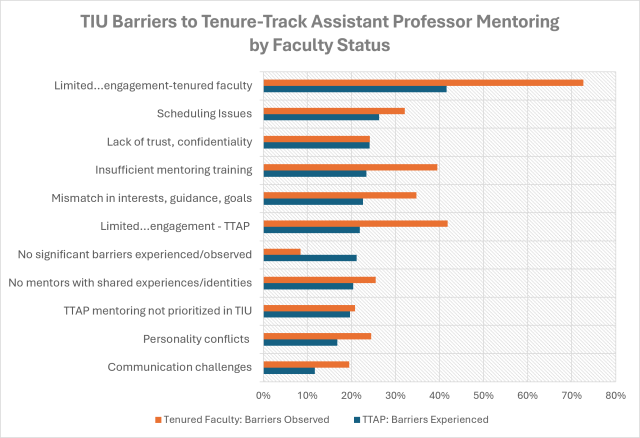
Despite this strength, significant barriers to effective mentoring remain. Interestingly—and somewhat paradoxically—the most commonly cited challenge is the limited time, interest, or engagement of senior faculty. TIUs are both the primary source of mentoring and, at the same time, perceived as the greatest barrier to effective mentoring. This seeming contradiction warrants closer examination.

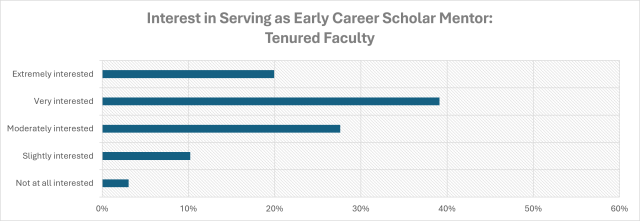
Interviews with department chairs, school directors, and college leadership point to two possible explanations for the variation in mentoring experiences across TIUs. One explanation is that levels of engagement in mentoring can differ significantly across faculty, which leads to uneven distributions of mentoring responsibilities. Another is that mentoring activities may be concentrated among a smaller subset of faculty who take on a larger share of this work. A question in the tenured faculty survey provides useful context: tenured faculty were asked about their interest in mentoring early career colleagues. A substantial majority—59%—reported being “extremely” or “very” interested in serving as mentors, and another 28% indicated moderate interest. These results reflect a strong base of interest and willingness to support colleagues.

Taken together, the evidence aligns more closely with the first explanation: variation in available time, interest, or capacity among a smaller portion of faculty may contribute to the perception that senior faculty can be a barrier to effective mentoring within TIUs. At the same time, faculty consistently report relying on senior colleagues within their TIUs for essential information and guidance, underscoring the strength of local mentoring relationships and the shared commitment to supporting early career colleagues.

Additional patterns in the data show similar dynamics. For example, department chairs and school directors suggest that a lack of trust may serve as a barrier to effective mentoring, yet faculty themselves do not rank this among their top concerns. While some faculty mention trust related issues, no track identifies it as a top barrier. 
Overall, these findings highlight the strong foundation of mentoring interest across the faculty while also illustrating how a relatively small set of experiences can influence broader perceptions. Recognizing this dynamic offers an opportunity to strengthen communication, clarify expectations, and build on the substantial mentoring capacity already present within TIUs. This perspective helps explain the paradox in which TIUs are viewed both as the primary source of mentoring and, at times, as a perceived barrier to it.

Beyond the TIU, tenure-line faculty also participate in other forms of mentoring at the college, university, and outside the university. They are engaged as both mentors and mentees in programs offered at Ohio State such as the FAME Program and Faculty Leadership Institute (FLI) in the College of Medicine, the BTAA Academic Leadership Program, President and Provost’s Leadership Institute (PPLI), and initiatives through the Drake Institute for Teaching and Learning. Many faculty also mention involvement in professional societies, where they receive mentoring or serve as mentors. Others highlight opportunities for coaching at the university, participation in workshops as attendees or leaders, and being a part of the National Center for Faculty Development and Diversity (NCFDD). Some have completed mentoring training, such as with the Center for the Improvement of Mentored Experiences in Research (CIMER). Still others note attending luncheons and networking events hosted by their colleges and the university.

In short, tenure-line faculty at Ohio State actively seek opportunities to learn and grow, drawing on resources from multiple sources. While the TIU remains the most critical space for mentoring, additional opportunities—whether at the college, university, or beyond—also play an important role. A significant minority of faculty participate in these programs. Importantly, mentoring may be formal or informal, and faculty often serve as both mentors and mentees. 
Nevertheless, there are significant opportunities for growth, expansion, and innovation in how faculty mentoring is approached at Ohio State. Below, descriptive results from the faculty mentoring surveys are presented and key findings that reflect tenure-line faculty’s perspectives and experiences with mentoring by career stage are highlighted. These insights are essential for identifying specific, tailored strategies to better support faculty success.

Faculty Mentoring as Tenure-Track Assistant Professors

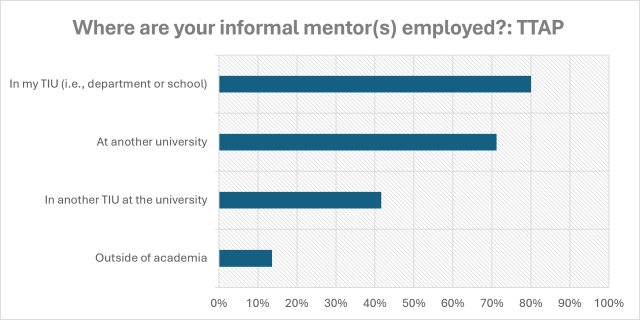
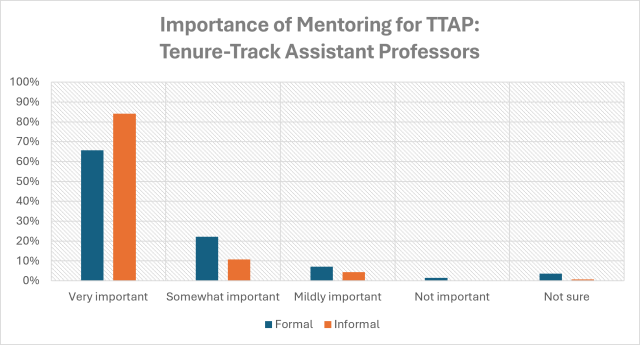
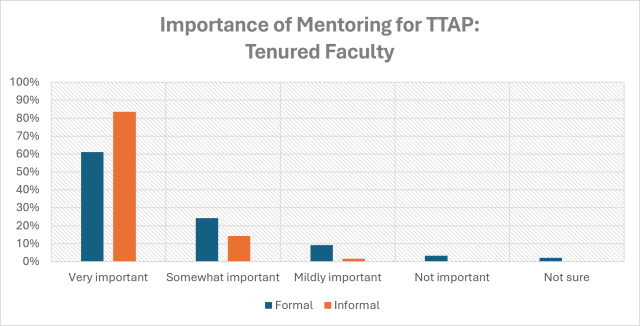
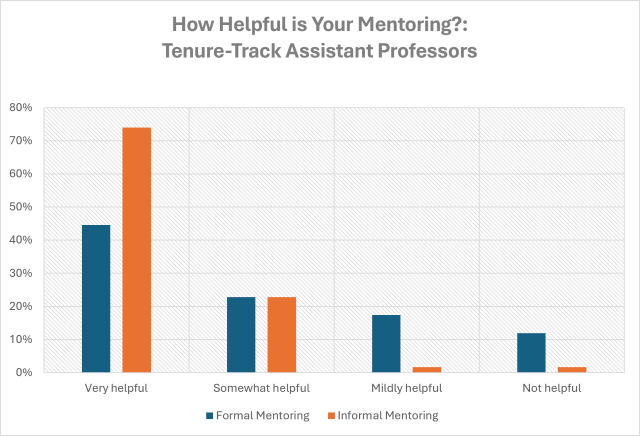
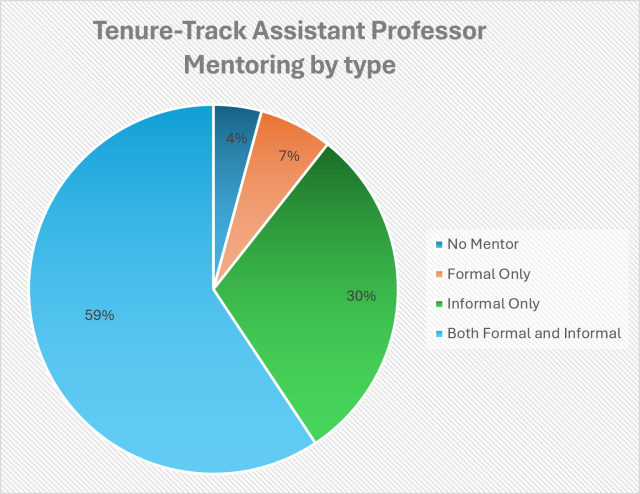
Among tenure-track assistant professors (TTAPs), mentoring is widespread but varies in form Most (59%) benefit from both formal and informal mentoring, while 30% rely solely on informal mentoring, 7% have only formal mentoring, and 4% report no mentoring at all. Moreover, informal mentoring stands out as the most valued resource—84% of TTAPs rate it as very important compared to 66% for formal mentoring, and 74% find informal mentoring very helpful versus 45% for formal mentoring. Tenured faculty share this view: 84% consider informal mentoring very important for TTAPs, compared to 61% for formal mentoring. Encouragingly, of TTAPs who have informal mentors, 80% report having at least one informal mentor within their TIU, with additional support from mentors at other universities (71%).

TTAP Mentoring and Professional Goal Achievement

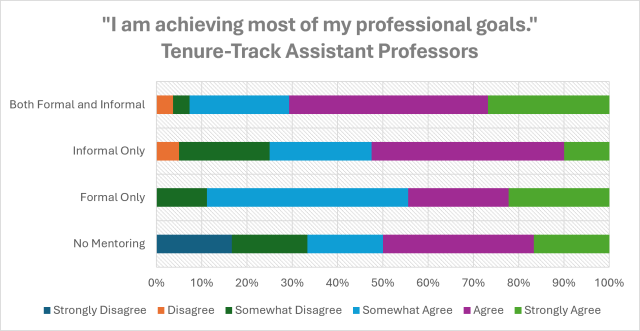
The data suggests a strong relationship between mentoring and perceptions of professional success among tenure-track assistant professors. Those who receive both formal and informal mentoring report the highest sense of achievement, with 71% agreeing or strongly agreeing with the statement, “I am achieving most of my professional goals.” In comparison, 53% of faculty who have experienced only informal mentoring, 50% with no mentoring, and 44% with formal mentoring only share this view. Notably, strong agreement is most common among those with both types of mentoring (27%), while tenure-track assistant professors without any mentoring are the only group where some strongly disagree (17%) with the statement, “I am achieving most of my professional goals.” These findings highlight the critical role of informal mentoring—even as formal mentoring remains an important component of faculty development.

Barriers to Effective TIU TTAP Mentoring

The most frequently cited barrier to TTAP mentoring experienced by tenure-track assistant professors is limited time, interest, or engagement of tenured faculty within their TIU. Forty-two percent identify this as a challenge. When we look at tenured faculty’s thoughts on barriers to effective TTAP mentoring in their units, we see that an even larger share of them—73%—see it as a primary obstacle. Interestingly, 21% of TTAPs report no significant barriers. Overall, tenured faculty are far more likely than tenure-track assistant professors to identify barriers impacting effective TTAP mentoring in their units. This reveals a rather significant perception gap between tenure-track assistant professors and tenured faculty when it comes to TTAP mentoring. Qualitative research could help unpack this finding. At first glance, it may reflect tenured faculty’s access to the breadth of their peer colleagues’ perspectives and level of involvement.

Critical TTAP Mentoring Areas

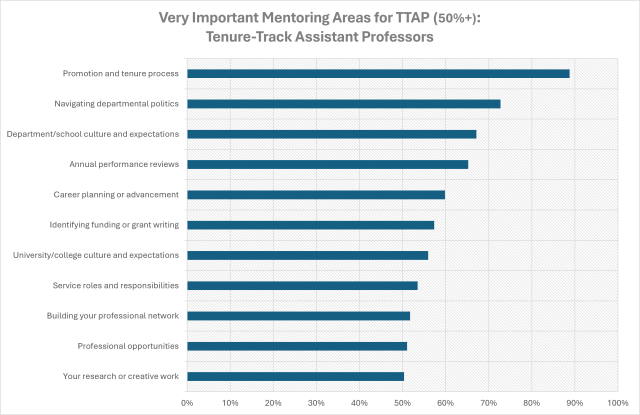
Mentoring areas rated as very important for TTAPs by at least 50% of respondents reveal clear priorities:

  • Promotion and tenure guidance (89%)
  • Navigating departmental politics (73%)
  • Understanding department or school culture and expectations (67%)
  • Annual performance reviews (66%)

Interestingly, just 50% of TTAPs rated research and creative work as a very important mentoring area. 

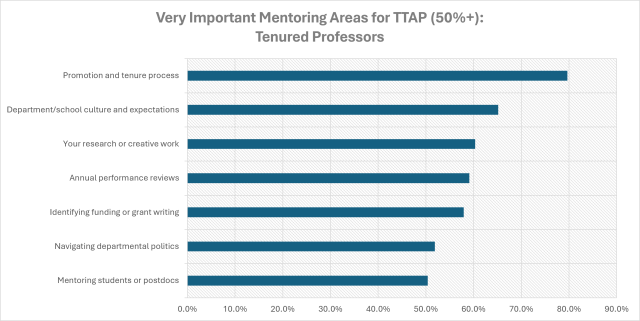
The tenured faculty survey asked participants to rate the importance of various mentoring areas for tenure-track assistant professors (TTAPs). Tenured associate professors show similar patterns as tenure-track assistant professors, while tenured professors emphasize fewer areas, prioritizing promotion and tenure (80%), department culture (65%), and research and creative work (60%). Notably, only tenured professors highly rate guidance on mentoring students or postdocs as very important (50%) for TTAP. Nevertheless, across all ranks, promotion and tenure direction dominates as the most critical mentoring area.

Sources of Success as TTAPs

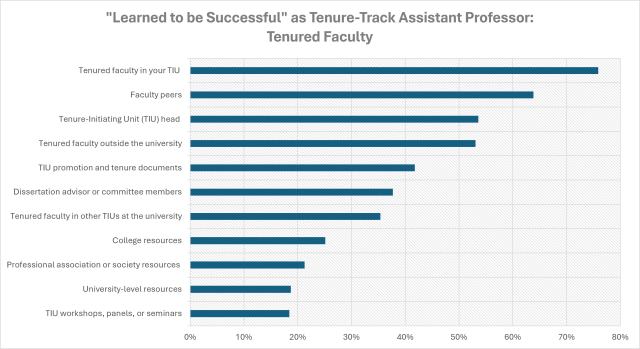
When asked where they learned to succeed as TTAPs, tenured faculty most often cite senior colleagues within their own department or school (76%), followed by faculty peers inside or outside the department (64%). Department heads or school directors rank third (54%). Other resources include faculty outside the university, promotion and tenure documents, and dissertation advisors. This aligns with where tenure-track assistant professors say their informal mentors are employed. These findings also highlight the central role of faculty mentoring within academic units and that Ohio State TIUs have a strong base of faculty mentoring for TTAPs, an encouraging sign. 

Key Takeaways: OSU Tenure-Track Assistant Professor Mentoring

Mentoring for tenure-track assistant professors at Ohio State is common but varies in form, with informal mentoring considered the most valuable. Faculty view TTAP mentoring as critical to tenure-track assistant professors’ professional success, especially when both formal and informal support are available. The primary barrier to effective mentoring of TTAPs is limited interest, time and engagement of tenured faculty, while key priorities include mentoring in promotion and tenure guidance, navigating departmental politics, and understanding departmental culture. Additionally, informal mentors are most often found within faculty members’ own units, and tenured faculty report learning to succeed as tenure-track assistant professors primarily through senior colleagues in their TIUs—suggesting that Ohio State has an already established foundation of mentoring for TTAPs at the department and school level.

Faculty Mentoring as Tenured Associate Professors

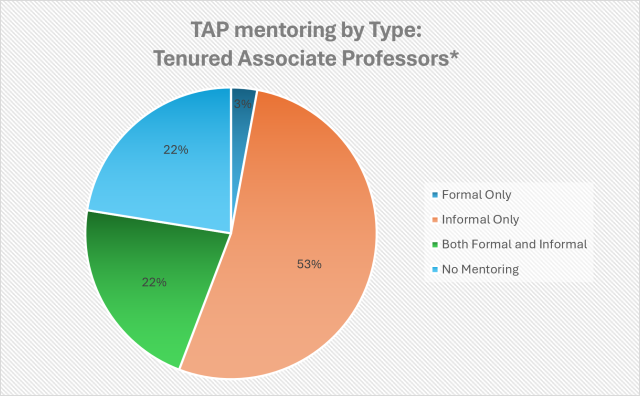
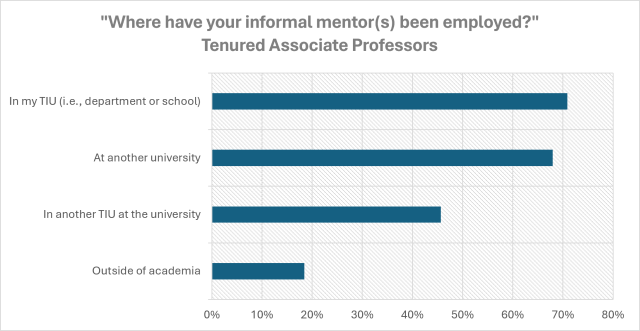
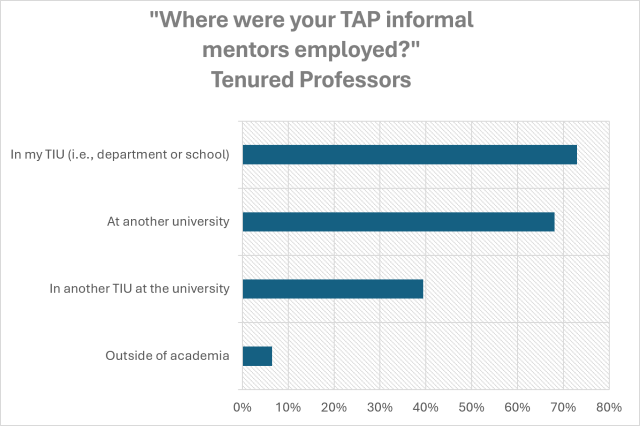
Among tenured associate professors (TAPs), 53% have only informal mentoring, 3% have only formal mentoring, 22% have both formal and informal mentoring, and a sizeable minority—22%—report no mentoring at all. Informal mentoring for TAPs occurs both within departments and beyond the university. The most common location for informal mentors is within the TIU (71%), followed closely by mentors at other universities (68%). A substantial minority also have mentors from other TIUs at Ohio State (46%). 

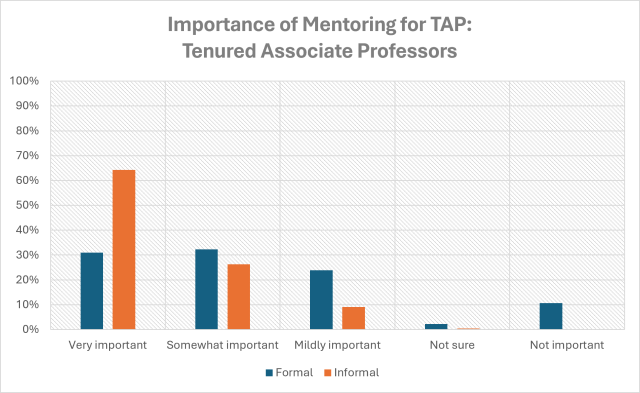
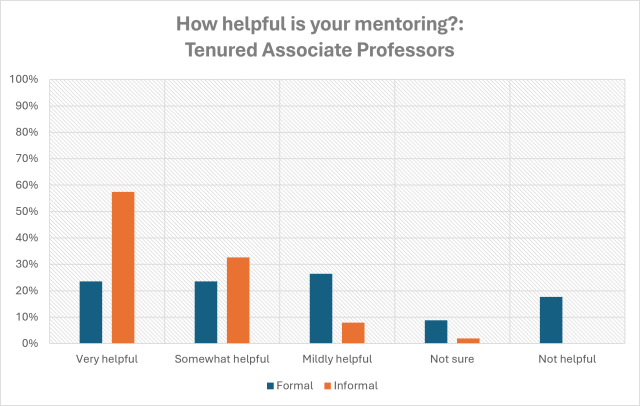
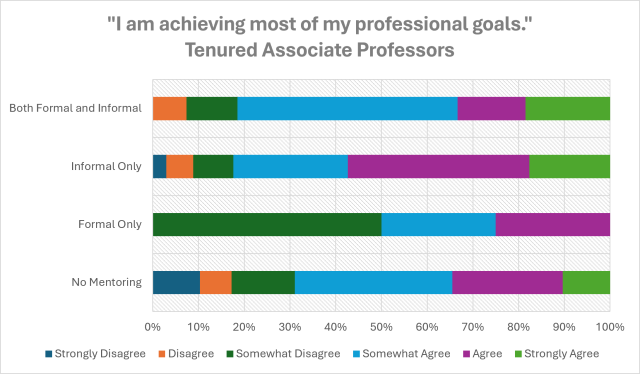
When asked about the importance of mentoring, most TAPs rate informal mentoring as very important (64%), consistent with patterns seen among tenure track assistant professors. In comparison, 31% consider formal mentoring very important, and 10% report that formal mentoring is not important to them. Perceived helpfulness follows a similar pattern: 57% rate informal mentoring as very helpful, compared to 24% for formal mentoring, and 18% indicate that formal mentoring is not helpful. TAPs with only informal mentoring are the most likely to agree or strongly agree (57%) that they are achieving most of their professional goals, followed by those with both formal and informal mentoring (33%). These findings highlight the central role that informal mentoring plays in faculty success and its perceived effectiveness across ranks.

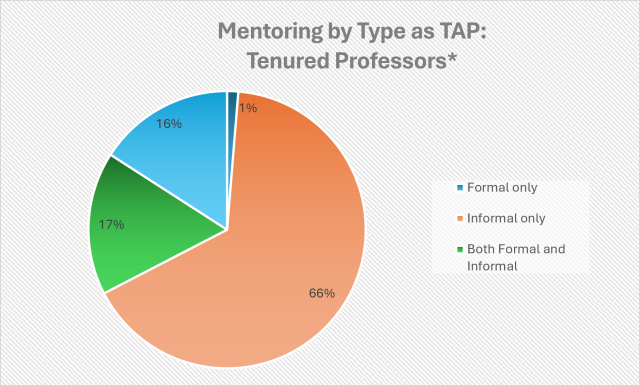
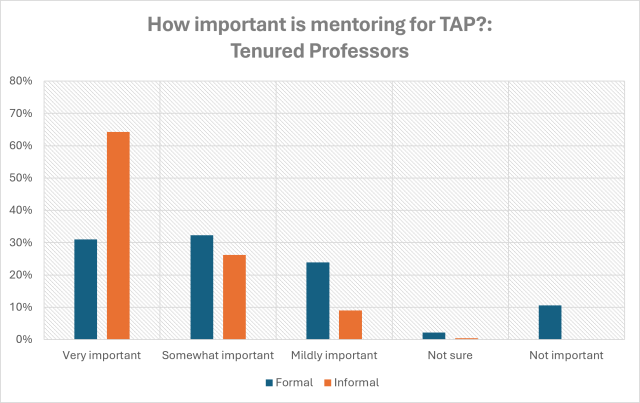
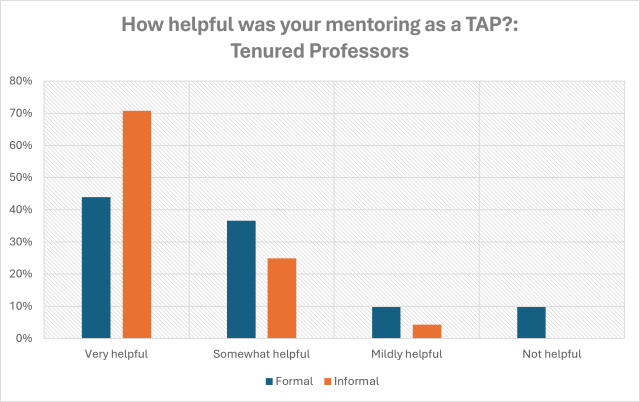
When reflecting on their time as tenured associate professors, most tenured professors report relying primarily on informal mentoring as well. Sixty six percent say they had only informal mentoring as TAPs, while 17% had both formal and informal mentoring, 16% had no mentoring, and just 1% had formal mentoring only. Consistent with what current tenured associate professors report, tenured professors also indicate that informal mentoring was far more important and helpful than formal mentoring. Sixty four percent rate informal mentoring as very important, compared to 31% for formal mentoring. In terms of helpfulness, 71% say informal mentoring was very helpful, while 44% say the same about formal mentoring. A small percentage found formal mentoring not helpful at all. Together, these findings reinforce the strong preference for informal mentoring and its perceived effectiveness.

College and University Formal Mentoring for TAPs

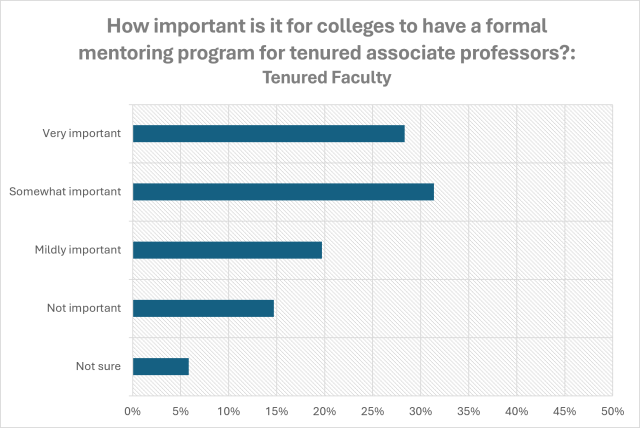
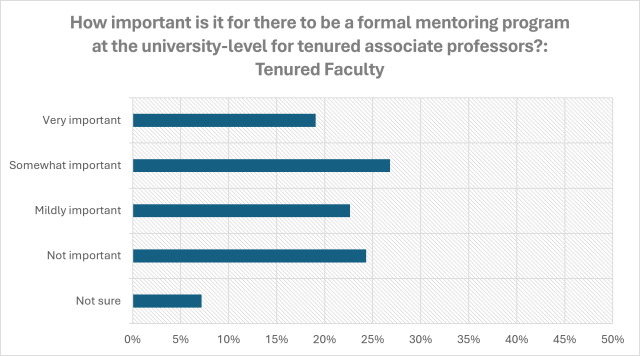
 When it comes to formal mentoring programs offered by colleges for tenured associate professors, 60% of tenured faculty believe it is very important or somewhat important for colleges to provide such programs. Additionally, 46% of tenured faculty indicate that having a formal mentoring program for tenured associate professors at the university level is very or somewhat important. These data underscore a demand for structured support beyond informal networks and TIUs. 

Sources of Success as Tenured Associate Professors

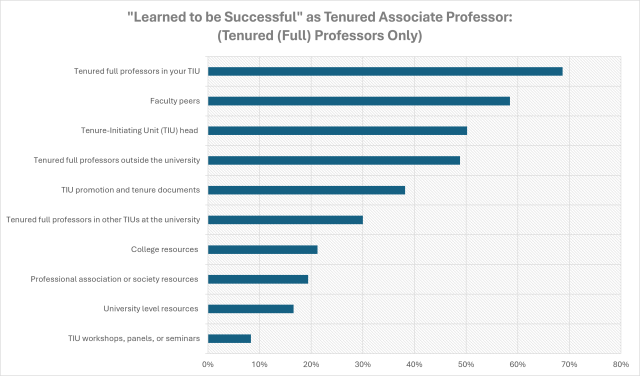
Tenured professors were asked where they learned to be successful during their time as tenured associate professors. Similar to findings for tenure-track assistant professors, the top three sources are:

  1. Tenured professors within their TIU (69%)
  2. Faculty peers, inside or outside their TIU (59%)
  3. Their TIU head (51%)

This is encouraging, as it again suggests strong mentoring networks within departments and schools that help faculty navigate career success. Additional sources include tenured professors outside the university and TIU promotion and tenure documents. 

Critical TAP Mentoring Areas

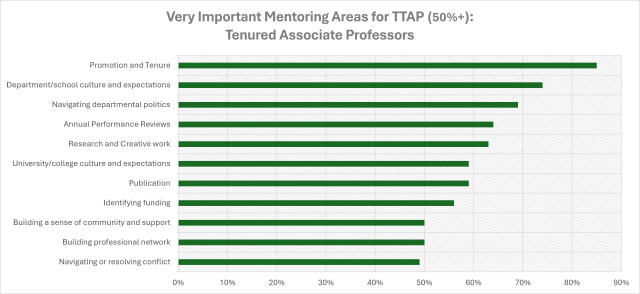
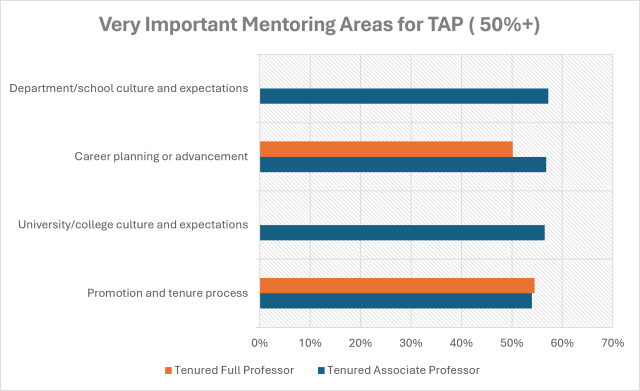
When focusing on mentoring areas rated as very important by at least 50% of respondents, four priorities emerge for tenured associate professors (TAPs):

  1. Department or school culture and expectations (57%)
  2. Career planning and advancement (57%)
  3. University or college culture and expectations (57%)
  4. Promotion and tenure process (54%)

Tenured professors identify two areas that meet the same threshold for TAP mentoring: career planning and advancement (50%) and the promotion and tenure process (56%). This comparison reveals an important insight: tenured associate professors are looking for broader guidance—especially around culture, expectations, and navigating their roles—while tenured professors tend to emphasize just advancement and promotion.

This gap highlights a meaningful opportunity

 TAPs desire mentoring that helps them understand and navigate both departmental and institutional cultures, clarifies expectations for their roles, in addition to advancing their careers. Tenured professors, meanwhile, emphasize expertise in promotion pathways and long term career development. Together, these perspectives point toward an opportunity for a more aligned mentoring approach—one that integrates clarity on expectations with strategic career guidance and positions TAPs for continued success.

Barriers to Effective TIU TAP Mentoring

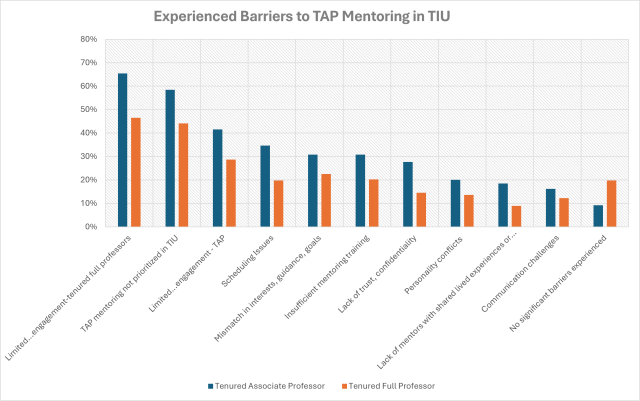
When examining barriers to effective mentoring within TIUs, we looked at the experiences of current tenured associate professors as well as tenured professors reflecting on their time in that role. A key pattern emerges: current tenured associate professors report higher levels of barriers than tenured professors recall experiencing. While this difference is understandable, it also highlights another important opportunity. If tenured professors do not perceive these barriers as strongly, they may be less aware of the support tenured associate professors are seeking—especially in areas such as department and college culture and expectations, which TAPs consistently identify as essential.

Even with these differences in intensity, both groups show strong alignment in how they rank specific barriers. The most significant challenge is the limited time, interest, or engagement of tenured professors. The second is the lack of prioritization of mentoring for tenured associate professors within TIUs. The third is the limited time, interest, or engagement of tenured associate professors themselves—many acknowledge they are not always able to fully invest in being mentored. Nearly 20% of tenured professors report experiencing no significant barriers when they were TAPs, further underscoring the perception gap and the need for clearer communication about current mentoring realities.
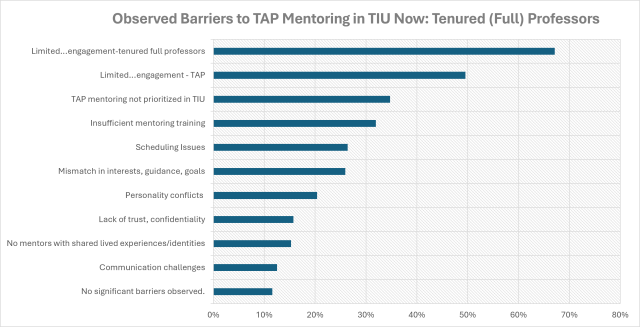
Tenured professors were also asked about barriers they currently observe within their TIUs. The most frequently cited challenge—by a wide margin—is again the limited time, interest, or engagement of tenured professors (67%). The second most common barrier, reported by 50%, is limited time, interest, or engagement among tenured associate professors. Third, 35% note that mentoring for TAPs is not prioritized within their TIU. Together, these responses suggest that there is room for departments and schools to strengthen their mentoring culture for tenured associate professors.

Current TAPs echo these observations. Sixty five percent report that limited time, interest, or engagement from tenured professors is a barrier to receiving effective mentoring. Fifty nine percent say mentoring is not prioritized in their department or school, and 42% acknowledge that their own limited time, interest, or engagement contributes to the challenge. This shared recognition—across both mentors and mentees—creates a promising foundation. It signals openness, honesty, and a collective desire to improve.

These findings point to a clear path forward: build a more intentional, visible, and supportive mentoring culture for tenured associate professors—one that affirms the value of mentoring for both those seeking guidance and those providing it. With shared commitment, TIUs can create environments where mentoring is not only available but actively valued, strengthening the professional growth and long term success of tenured associate professors as well as the TIUs themselves.

Key Takeaways: OSU Tenured Associate Professor Mentoring

Mentoring for tenured associate professors (TAPs) shows strong foundations and clear opportunities for growth. Most TAPs rely on informal mentoring, which they consistently rate as more important and more helpful than formal mentoring, and those with informal mentors are the most likely to feel they are achieving their professional goals—highlighting the strength of the organic networks within TIUs. At the same time, both TAPs and tenured professors identify limited time, interest, or engagement from tenured professors as the primary barrier to effective TAP mentoring, along with a shared sense that mentoring for TAPs is not always prioritized within TIUs. TAPs also articulate specific needs—clarity on expectations, career planning, and promotion processes—while tenured professors tend to focus more narrowly on advancement, suggesting an opportunity to align perspectives and broaden mentoring conversations. 

TIUs remain central, as they are the primary source of informal mentors, and tenured professors overwhelmingly credit senior colleagues in their units for their own success as TAPs. Though formal mentoring by TIUs is not viewed as central to their success, many TAPs express interest in formal, structured mentoring at the college or university level. Because most have not experienced formal and informal mentoring together, the combined impact is not yet known, but TAPs clearly seek complementary support that reinforces the informal networks they value. 
Taken together, strengthening informal mentoring within TIUs while developing well designed formal programs at higher levels can create a mentoring ecosystem that is both relationship rich and structurally supportive, better aligned with TAPs’ needs, and positioned to advance their long term professional success.

Faculty Mentoring as Tenured Professors

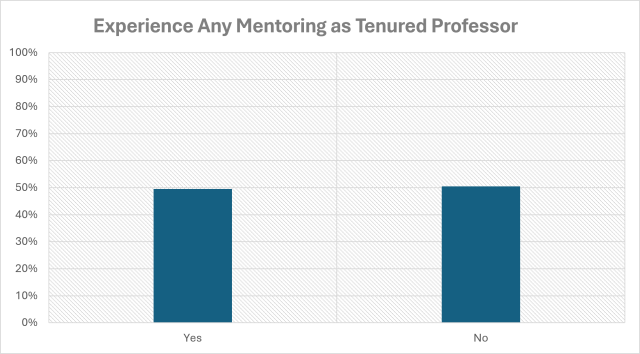
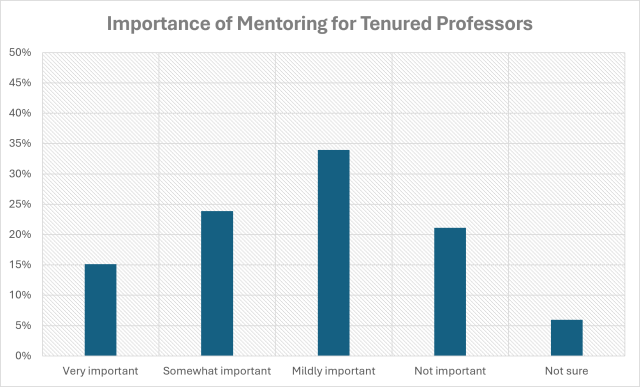
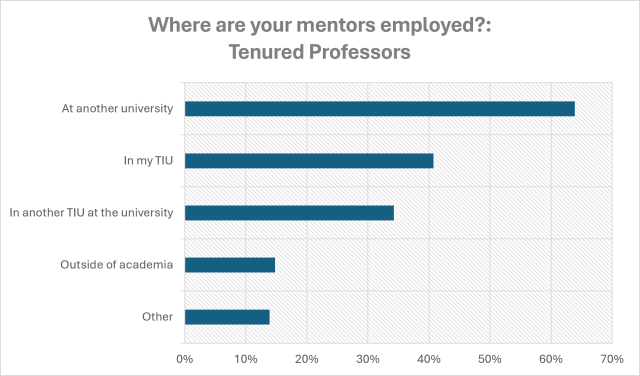
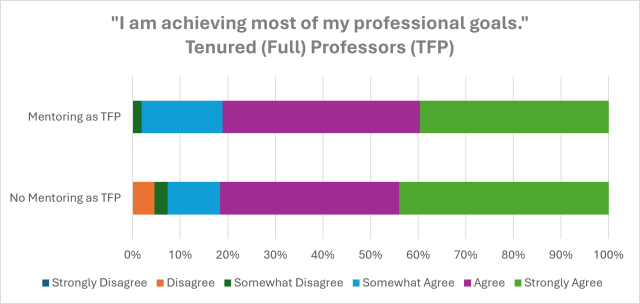
About half of Ohio State’s tenured professors in the study report having experienced mentoring—formal or informal—at this career stage. Yet only 15% consider mentoring for tenured professors to be very important, with the most common response (34%) being that it is mildly important. Among those who do have mentors, many (64%) look beyond Ohio State for support, though a substantial number find guidance within their own departments or schools (41%) or across the university in other TIUs (31%). Mentoring does not appear to dramatically shift perceptions of goal achievement, though those without mentors are slightly more likely to feel they are falling short: about 7% of tenured professors without mentoring disagree or somewhat disagree that they are achieving most of their professional goals.

Qualitative insights provide greater clarity on tenured professors’ mentoring experiences. They describe a mentoring landscape shaped largely by informal and peer relationships, with administrators and retired colleagues—highlighting the continued contributions of emeriti faculty to a supportive academic culture. Many tenured professors emphasize the value of sustaining mentoring relationships throughout their careers, maintaining ties with dissertation advisors and finding support through grant collaborations, writing groups, research partnerships, and professional networks. These patterns suggest that mentoring continues to influence tenured professors’ professional trajectories, even if it is not always formally recognized as such.

The data also demonstrate that mentoring needs do not end once faculty become tenured professors. Many express interest in continued growth and development, and their qualitative responses point to certain priorities. Leadership and administration top the list, with faculty seeking pathways into leadership roles, preparation for administrative responsibilities, and strategies for effective networking. Those already in leadership roles express interest in practical skills such as managing budgets and personnel. Career planning follows closely, including long term goal setting, strategic planning, salary negotiations, and retirement transitions. Research productivity and funding remain central, with interest in grant writing, securing large scale funding, and increasing research impact. Less frequent but still notable mentoring needs include guidance on teaching and mentoring, work life balance, and conflict resolution.

Key Takeaways: OSU Tenured Professor Mentoring

About half of Ohio State’s tenured professors report having experienced mentoring—mostly informal or peer based—yet only 15% view mentoring at this stage as very important. Many maintain long standing relationships with dissertation advisors and rely on networks connected to grant collaborations, writing groups, emeriti faculty, and peers in their TIUs for guidance. While mentoring does not strongly correlate with perceptions of goal achievement, those without mentors are slightly more likely to feel they fall short of achieving their professional goals. Qualitative responses reveal clear areas for continued growth: leadership and administration top the list, followed by career planning, research productivity, and funding, with additional needs in teaching, mentoring colleagues, work life balance, and conflict resolution. In short, mentoring needs do not end when faculty become tenured professors; there remain significant opportunities for development, and many tenured professors at Ohio State are eager to engage when meaningful avenues for support are available. With intentional support, Ohio State can continue to invest in the growth of its tenured professors—valuing their experience and expertise while helping them navigate the next stages of their academic careers.

Focus Group Findings: Clinical, Teaching, or Practice Faculty (CTP)

Most CTP faculty in the focus groups hold appointments primarily in teaching and clinical work, with a smaller number in research or practice roles. Across tracks, faculty express interest in more structure and community to support their work. Many note opportunities to bring greater clarity to promotion and reappointment expectations—criteria, timelines, and dossier requirements—and highlight the value of transparent guidelines, clear rubrics, and early communication from the start of their appointments. Several also emphasize the importance of including CTP perspectives on review committees.

Mentoring experiences vary widely, and many CTP faculty have built supportive relationships through peer networks, informal connections, and collaborations. At the same time, they see potential benefits in more coordinated, structured mentoring that begins at onboarding and continues through key career milestones, offering guidance on promotion, workload balance, and navigating departmental processes. Faculty also express interest in individualized, goal oriented mentoring that supports time management, advocacy, and understanding university culture.

Community and connection emerge as important themes. CTP faculty value peer learning circles, cross college networks, and opportunities to share teaching innovations, shadow colleagues, and build relationships—approaches that can be especially helpful for remote faculty. Some note that greater shared understanding of CTP roles across faculty tracks could further strengthen equity and belonging.

CTP faculty also express interest in deeper engagement with leadership and more centralized support, including sample dossiers, guidance on emerging trends such as AI in teaching, and shared resources that reduce duplication of effort. They are committed to their work and see meaningful opportunities for continued growth. Enhancing clarity, mentoring, and recognition through structured programs and strong networks could support long term success, morale, and retention for CTP faculty across the university.

Key Takeaways: OSU CTP Faculty Mentoring

CTP faculty describe opportunities to strengthen job clarity, mentoring, and recognition, noting that clearer structures in these areas would help them feel more connected to their units. Mentoring is widely viewed as important, and faculty express interest in approaches that are aligned with the specific responsibilities and career paths of CTP roles. In addition to cross college peer mentoring that supports community building and shared learning, they value programs that offer guidance on career advancement and navigating university systems. CTP faculty also note the benefits of targeted support to help them succeed in their positions; without it, there is a possibility of feeling less connected or fully understood, particularly given the substantial teaching and service responsibilities many carry.

Concluding Thoughts on the Findings 

The findings from peer institution reviews, conversations with university leaders, input from deans, associate deans, chairs, and directors, and the perspectives of both tenure line and CTP faculty offer a comprehensive view of mentoring at Ohio State and a clearer understanding of faculty needs across the university. Across groups, there is strong agreement that mentoring plays a vital role in faculty development, advancement, and overall professional well being. Leaders at the TIU, college, and university levels consistently emphasize mentoring as a key pathway through promotion and tenure and as an important contributor to retention and a healthy academic culture. The insights also highlight the central role TIUs already play in supporting faculty success and point to meaningful opportunities to strengthen both informal and formal mentoring—fostering inclusive, relationship based cultures within units while building intentional structures at the TIU as well as college and university levels. The findings affirm that faculty at every rank and career stage benefit from continued mentoring and growth. The recommendations that follow provide a framework for leaders and faculty to build on these strengths and move toward an environment where all faculty can flourish and achieve their goals. 
Ohio State University: Empowering Faculty Through Mentorship

When mentoring is embraced and celebrated, faculty are empowered, departments are strengthened, and the university’s academic community as a whole thrives. A culture of mentoring is not simply about individual achievement—it is about building a shared environment where every faculty member can grow, contribute, and succeed. It flourishes in a culture of collaboration and mutual support—one that welcomes diverse ways for faculty to share and access knowledge and expertise and inspires individual, departments and schools, colleges, and universities to advance collective capacity.


Building on the insights from our multi method study, we now have a clearer understanding of the current faculty mentoring landscape at Ohio State and can turn our attention to what it will take to strengthen mentoring across the university. This next section introduces the overarching goals and guiding principles that emerged from the study, along with concrete guidelines for each unit level—TIUs, colleges and regional campuses, and the Office of Academic Affairs. Together, these components form a coordinated framework for shaping mentoring practices that are intentional, inclusive, and aligned across the institution. By clarifying shared aims and defining the complementary roles of each unit, this section lays the groundwork for a more connected and supportive mentoring culture—one that empowers faculty at every stage to grow, contribute, and thrive.

Goals of Faculty Mentoring at Ohio State

  • Share knowledge and expertise to advance faculty success through approaches that are accessible and equitable.
  • Promote individual faculty growth, success, and achievement.
  • Institutional excellence across the university, colleges, and tenure initiating units (TIUs).
  • Faculty retention.
  • Embed faculty into the broader academic community.
  • Foster a collaborative, mutual, inclusive faculty culture that spans all career stages and tracks, including emeriti.

Guiding Principles of Faculty Mentoring at Ohio State

  • Local Catalyst for Change. Tenure initiating units (TIUs) remain the central context in which faculty experience mentoring. They are the primary sites where relationships form, expectations are clarified, and professional growth occurs. Tenured professors play a pivotal role in cultivating, modeling, and sustaining a strong mentoring culture within their units, positioning TIUs as essential catalysts for impact and innovation.
  • Champions and Advocates. Colleges and regional campuses serve as champions of mentoring by supporting and amplifying the work of TIUs. They help ensure that mentoring efforts are visible, valued, and aligned with broader academic goals, while also facilitating the sharing of effective practices and fostering connections across units.
  • Vision and Purpose. The Office of Academic Affairs provides institutional leadership by articulating a clear vision for mentoring across career stages and appointment types. By setting expectations and aligning mentoring strategies with university priorities, the Provost’s Office reinforces mentoring as a core component of faculty success and institutional excellence.
  • Empowerment. Faculty are recognized as active participants in their own mentoring journeys. Effective mentoring empowers faculty to seek out, cultivate, and contribute to relationships that reflect their goals, values, and aspirations. This principle affirms that faculty serve as both mentors and mentees throughout their careers, shaping a culture of shared growth.
  • Consistent Messaging. A strong mentoring culture is reinforced through clear and consistent communication. When the value and purpose of mentoring are affirmed across platforms—led by the Provost and the Office of Faculty Affairs and echoed by colleges and regional campuses, and TIUs—it helps normalize mentoring as essential professional practice and clarifies shared expectations across the university. 
  • Collaboration and Mutuality. Mentoring is most effective when grounded in collaboration, reciprocity, and mutual investment in success. These values strengthen individual faculty, enrich TIUs and colleges, and contribute to a more connected and supportive academic community. A mentoring culture built on mutuality benefits both individuals and the institution. 
  • Flexibility and Freedom. There is no single model for effective mentoring. Flexibility, adaptability, and autonomy allow units to design mentoring approaches that reflect their unique cultures and respond to evolving faculty needs. This principle affirms that mentoring programs should remain nimble and responsive rather than prescriptive.
  • Dual Approach. Both formal and informal mentoring are essential components of a robust mentoring ecosystem. Formal mentoring provides clarity around expectations, processes, and institutional norms. Informal mentoring—often regarded by faculty as the most valuable—builds trust, fosters community, and supports knowledge sharing. Together, they create a comprehensive and supportive mentoring environment.
  • Diversity and Inclusion. Faculty bring diverse identities, experiences, strengths, mentoring styles, as well as varied needs to their work. These differences are acknowledged and affirmed, and contributions to mentoring—in all their forms—are recognized as vital to a thriving academic community. Inclusive mentoring practices ensure that all faculty can access the support they need to succeed.
  • Celebration. Mentoring is meaningful professional labor that contributes to individual and institutional success. Recognizing and celebrating mentoring contributions in affirming and innovative ways reinforces their value and encourages continued investment in mentoring across units.

Tenure Initiating Units: The Cornerstone of Faculty Mentoring

Tenure initiating units (TIUs) serve as the cornerstone of faculty mentoring. They are the environments where mentoring is most effective and where faculty consistently find the support that enables them to thrive. Our research shows that TIUs—especially for tenure line faculty—are the primary places where formal and informal mentoring relationships develop and where faculty receive the guidance necessary for success. For this reason, cultivating a robust mentoring culture within TIUs is essential.

There is no universal mentoring model; mentoring should be shaped to meet the unique needs of faculty and the unit. Both formal and informal mentoring play vital roles. Formal programs offer clarity around expectations, promotion processes, and departmental standards, giving faculty a reliable framework of support. Informal mentoring fosters collaboration, community, and the everyday knowledge sharing that faculty often value most. Together, they create a comprehensive and responsive system of support.

A mentoring culture should align with each unit’s mission, goals, and values. TIUs are encouraged to define these clearly and ensure they connect with college and university priorities. A shared vision provides a strong foundation for faculty success and guides the development and sustainability of an effective mentoring culture.

The strength of mentoring lies in cultivating a culture that celebrates collaboration, reciprocity, and mutual investment in success—for individual faculty and for the unit as a whole. TIUs are encouraged to build mentoring cultures that both guide faculty and empower individuals to shape their own mentor networks in support of their goals. This culture should be communicated consistently, framed positively, and focused on growth. It should inspire faculty, mentors, mentees, and entire TIUs to generously share knowledge and expertise, learning from one another and growing stronger together.
While all faculty contribute to a strong mentoring environment, tenured professors play a particularly important role in weaving mentoring into the fabric of the department. Through their example, leadership, and collegial engagement, they help set the tone and embed mentoring across all levels of the unit. TIU heads play a complementary role by amplifying this work and helping to institutionalize the mentoring culture that tenured professors collectively cultivate.

Recognition for mentoring should reflect the many ways faculty contribute to a strong mentoring culture. Faculty can engage through numerous on ramps: structured mentoring relationships such as one to one mentoring or mentoring pods; professional development workshops and panels; and organizing activities that spark organic, informal connections. Brief, targeted exchanges of knowledge also matter. In short, faculty can contribute to cultivating a culture of mentoring through many meaningful pathways—from formal programs to informal peer networks. With the exception of tenure track assistant professors, who are not expected to mentor others, all faculty participate in mentoring—as mentors, mentees, or both—strengthening a culture of shared growth and mutual support.


Mentoring Guidelines for Tenure Initiating Units (TIUs)

Each faculty member in a TIU helps cultivate a collaborative, reciprocal, and affirming mentoring culture. Faculty take on different roles and responsibilities—formal mentors, informal advisors, peer supporters, and role models—all of which strengthen a healthy and effective mentoring environment.

  1. Roles & Responsibilities
    1. Tenured Professors
      1.  Lead the mentoring culture by modeling collaboration, reciprocity, and a shared investment in colleagues’ professional success.
    2. Department Chairs and School Directors
      1. Amplify and institutionalize mentoring practices established by tenured professors.
    3. Other Faculty
      1. Tenured associate professors and Clinical, Teaching, and Practice (CTP) faculty, contribute through shared expertise, and collaboration across roles and ranks.
      2. Tenure track assistant professors are empowered to form mentoring relationships that support their growth but are not expected to mentor.

  1. Encourage Diverse Mentoring Approaches and Models

    Effective mentoring draws on multiple pathways, recognizing that faculty benefit from different forms of support across career stages and roles, and that certain approaches or models may be a better fit for some mentors than others. 

    1. Formal Mentoring Structures:
      1. Mentoring pods (peer or hierarchical).
      2. One-on-one relationships.
      3. Panels/workshops on promotion, tenure, and career advancement.
    2. Other Mentoring Opportunities:
      1. Coffee chats, lunches, and colloquia for affinity groups or those with shared interests.
      2. Expertise based panels and workshops (e.g., grant writing, publishing, community engagement, leading a lab).
      3. Professional development sessions (e.g., time management, conflict navigation, well being). 
      4. Events that create informal mentoring opportunities.

  1. Recognition and Celebration of Mentoring
    1. Promote a culture that celebrates collaboration, reciprocity, and mutual investment in success for faculty and units.
    2. Encourage faculty to reflect on and document their mentoring efforts.
    3. Mentoring contributions should be acknowledged in annual reviews and promotion and tenure (P&T) documents.
    4. Recognition should be broad, inclusive, and celebratory of diverse mentoring activities.
    5. Celebrate and make visible the many ways mentoring occurs, honoring the diverse strengths and approaches that help faculty succeed.

Colleges and Regional Campuses: Faculty Mentoring Champions

Colleges and regional campuses play an important role in fostering a mentoring culture that complements TIU efforts while honoring each unit’s mentoring approaches, unique needs, disciplinary norms, and local cultures. This culture should emphasize collaboration, reciprocity, and shared investment in success—supporting individual faculty, strengthening TIUs, and advancing the college’s mission and vision. To that end, colleges and regional campuses can champion a range of mentoring approaches—such as one on one relationships, peer mentoring pods, interdisciplinary groups, and external mentoring connections—tailored to faculty interests, career stages, and disciplinary expectations.

As part of cultivating this culture, colleges and regional campuses can also support tenured professors, who play a central role in shaping inclusive, supportive, and affirming mentoring within TIUs. Providing guidance, resources, and recognition helps these faculty make mentoring a celebrated and integral part of departmental life, while also equipping TIU heads to amplify and institutionalize strong mentoring practices across their units.

While both formal and informal mentoring matter, OSU faculty consistently describe informal mentoring as the most valuable. Colleges and regional campuses can help cultivate these relationships by creating community building spaces—coffee talks, lunch gatherings, affinity group colloquia, and similar activities—that encourage supportive professional connections. Grants for peer mentoring pods, support for external mentoring relationships, and modest stipends for mentors signal strong institutional commitment. At the same time, structured college level mentoring can complement the mentoring that takes place in TIUs and support networking beyond departments and schools. Programs built around structured mentoring pods—whether peer based or hierarchical—running for a semester or a full academic year have been found to be a successful model to foster supportive connections, interdisciplinary collaboration, and professional growth. While these programs can serve all faculty, they would be especially helpful for tenured associate professors and CTP faculty.

Recognition is vital to sustaining a strong, affirming mentoring culture. Colleges and regional campuses can celebrate mentoring excellence through annual awards, appreciation events, and acknowledgment in annual reviews and P&T documents, ensuring recognition reflects the many ways faculty contribute—whether through 1:1 mentoring, mentoring pods, or sharing experiences and expertise in workshops and panels. Communication about mentoring should be consistent and positive across the college, using language that celebrates faculty contributions, reinforces mentoring as a shared responsibility, and highlights its role in advancing individual success and the mission, values, and goals of TIUs, the college or regional campus, and the university.


Mentoring Guidelines for Colleges and Regional Campuses
Roles & Responsibilities

  1. Complementary Role of Colleges and Regional Campuses
    1. Reinforce TIUs as the cornerstone of faculty mentoring.
    2. Advance faculty mentoring by supporting mentoring priorities of TIUs and connecting faculty across units.
    3. Amplify effective practices that respect unique disciplinary cultures and supports local mentoring needs.

  1. Cultivate a Mentoring Culture
    1. Promote a mentoring culture of collaboration, reciprocity, and shared investment in faculty and unit success.
    2. Communicate consistently that mentoring is valued professional work.
    3. Encourage diverse mentoring practices that reflect disciplinary cultures and faculty needs.

  1. Provide Resources and Other Support
    1. Invest in resources that strengthen mentoring efforts, such as:
      1. Grants for peer mentoring pods (e.g., affinity groups, research teams, interdisciplinary cohorts)
      2. Funding to support external mentoring relationships (travel, honoraria, campus visits)
      3. Recognition and modest stipends for faculty who take on substantial mentoring roles
    2. Create and encourage informal networking opportunities—coffee chats, lunches, colloquia, and similar gatherings—that build connection and community.

  1. Develop Programming
    1. Organize workshops on professional practices and development. Topic suggestions include:
      1. Grant writing, publishing, community engagement, building an international reputation, career progression strategies, leading a lab, national service, and research, among others.
    2. Host panels and discussions on personal development. Topic suggestions include:
      1. Time management, navigating conflict, professional well-being, among others.

  1. Support for Specific Faculty Groups
    1. Provide targeted mentoring specific faculty groups through cross-unit, interdisciplinary programming that fosters networking and knowledge-sharing. Tenured associate professors and CTP faculty have current needs. Suggested programs are:
      1. Programming for structured mentoring pods—peer-based or hierarchical—that run for at least one semester, ideally across the academic year.
      2. Activities that create opportunities for informal interactions with senior colleagues and peers across TIUs, helping build professional networks and strengthen the college’s academic community.

  1. Celebration, Recognition and Accountability
    1. Encourage, provide guidance on, and acknowledge mentoring contributions in annual reviews and promotion and tenure (P&T) documents.
    2. Establish awards and celebratory events for:
      1. Individual faculty mentors who demonstrate exceptional commitment to mentoring.
      2. TIUs that demonstrate excellence in fostering a strong faculty mentoring culture.
    3. Ensure recognition of mentoring efforts is inclusive and celebratory, highlighting diverse mentoring styles and contributions.

  1. Partnership with TIUs
    1. Collaborate with TIUs to:
      1. Share best practices.
      2. Provide guidance on incorporating mentoring into evaluation processes.
      3. Support units in tailoring mentoring programs to their unique cultures.

  1. Leadership and Sustainability
    1. Encourage and support tenured professors to collectively cultivate and lead mentoring efforts within their TIUs.
    2. Encourage and support department chairs and school directors as they amplify and institutionalize mentoring practices established by tenured professors in their TIU.
    3. Deliver consistent communication and resources to encourage and sustain mentoring initiatives over time.

Provost’s Office: Strengthening Faculty Through Shared Community and Purpose

This university-wide faculty mentoring initiative has established shared mentoring goals and expectations that highlight and celebrate the essential work of TIUs, colleges, and regional campuses. These units have long provided the foundation for faculty mentoring, and their expertise, creativity, and commitment continue to strengthen the university’s mentoring culture. Building on this strong base, the Provost’s Office is committed to reinforcing mentoring as a meaningful institutional priority and shared responsibility, while continuing to recognize and honor the vital role these units play in supporting faculty success.

The university is committed to maintaining a thoughtful balance between shared standards and local flexibility. Supporting TIUs and colleges and regional campuses as they design mentoring approaches that reflect their disciplinary cultures and priorities—while aligning with university‑wide expectations—ensures that mentoring practices remain both strong and responsive to faculty and local needs.

Looking ahead, the Office of Academic Affairs will continue to seek opportunities to further strengthen mentoring by investing in initiatives that connect faculty more fully with the broader academic community. As part of OAA’s commitment to strengthening faculty success, it aims to build a more coordinated mentoring ecosystem—one that combines structured programs with informal opportunities for connection to deepen relationships, expand networks, and support faculty across career stages.

Recognizing mentoring contributions is equally essential. The university can demonstrate its commitment by ensuring that mentoring is visible in institutional policies, annual reviews, and promotion and tenure documents, and by celebrating strong mentoring cultures through awards and other forms of acknowledgment.

OAA commits to partnering with the Graduate School to create a coherent mentoring pathway that extends from graduate education through faculty careers. Establishing this continuum would affirm the importance of graduate mentoring, strengthen the long‑term academic community, and contribute to supporting a strong alumni network.

Together, these commitments reflect a clear institutional aspiration: to build a robust, connected, and supportive mentoring culture that strengthens faculty success and honors the essential work of TIUs, colleges, and regional campuses while ensuring the university plays an active and accountable role in advancing faculty success.


Mentoring Guidelines for the Provost’s Office

  1. Communicate Institutional Commitment 
    1. Affirm faculty mentoring as a strategic priority essential to both faculty growth and institutional excellence.
    2. Acknowledge and elevate the strong mentoring already happening across academic units and communicate OAA’s commitment to sustaining and amplifying this work.
    3. Highlight how mentoring contributes to a vibrant academic community where faculty thrive and the university advances its mission.

  1. Expectations and Role Clarity
    1. Ensure faculty understand their responsibilities and how their work aligns with the university’s mission, vision, and goals.
    2. Provide clear, supportive written guidance tailored to each career stage and appointment type.
    3. Clarify mentoring expectations across roles in ways that honor disciplinary differences and recognize unit level expertise.
    4. Equip academic units with the resources and structures needed to cultivate collaborative, inclusive, and effective mentoring environments.

  1. Recognition and Accountability 
    1. Acknowledge the full range of mentoring activities—formal and informal—in institutional policies, annual reviews, and promotion and tenure processes.
    2. Celebrate strong mentoring cultures within TIUs, colleges, and regional campuses, honoring the essential work already happening across units.
    3. Recognition strategies may include:
      1. Annual faculty mentoring awards
      2. OSU Faculty Mentoring Honors Society
      3. Celebratory events and banquets
      4. Public acknowledgment through university communications
      5. Incentives for colleges and regional campuses, such as grants to support mentoring initiatives or mentoring leadership certification

  1. Communication Strategy 
    1. Communicate consistently—across platforms and from the Provost’s Office through colleges, campuses, and departments—to reinforce mentoring as a shared institutional priority. 
    2. Clearly articulate mentoring goals in ways that highlight its impact on faculty success, institutional excellence, and a culture of shared responsibility.

  1. Flexibility and Local Innovation 
    1. Maintain shared institutional standards while granting colleges, TIUs, and regional campuses the flexibility to design mentoring approaches that reflect their unique disciplines and cultures.
    2. Encourage innovation and adaptability as faculty needs evolve.

  1. Integration Across Career Stages
    1. Partner with the Graduate School to create a seamless mentoring pathway from graduate education through faculty hiring, professional development, and advancement.
    2. Recognize the enduring role of dissertation advisors for long-term faculty success and integrate graduate mentoring into the broader university mentoring culture, strengthening the long term academic community.

  1. Promote Structured and Informal Mentoring Opportunities
    1. Develop university wide, extended mentoring programs that support faculty success and communicate university level expectations at pivotal career stages.
    2. Support programming and events that foster organic, cross unit connections among faculty, complementing the mentoring efforts of TIUs, colleges, and regional campuses.

  1. Monitor and Evolve Mentoring Initiatives
    1. Establish collaborative feedback mechanisms and regularly review mentoring programs to ensure they remain responsive to faculty needs and aligned with institutional priorities.
    2. Use assessment findings to refine and strengthen mentoring initiatives over time.

Study Strengths and Limitations

This mentoring initiative employed a comprehensive, multi method design and invited participation from the full population of stakeholders most directly involved in faculty mentoring at Ohio State. This approach provided both a broad and nuanced understanding of mentoring perspectives, experiences, practices, and models. All college and regional campus deans and associate deans of faculty affairs were invited to participate in interviews, and nearly all did so. All department chairs and school directors were also invited to join focus groups, and many contributed their insights. These conversations added important qualitative depth and offered contextual understanding that complemented the survey findings. In addition, all CTP faculty were invited to participate in a focus group. The conversations fostered open, transparent, and engaging dialogue that offered valuable insight into their unique experiences. While broader participation from practice faculty and from more CTP faculty outside medical fields would have perhaps added further nuance, the main topics that emerged during our discussions were not discipline-specific and were relevant across colleges and TIUs. Substantial insights were also gained from peer institutions. Their mentoring programs and conversations with several of university leaders at these institutions illuminated effective strategies and inspired several of the recommendations in this report.


All eligible tenure line faculty at OSU were invited to complete a faculty mentoring survey, resulting in participation from a substantial cross section of colleges, campuses, and faculty roles. The survey responses generated a rich body of knowledge about OSU tenure line faculty and their mentoring perspectives and experiences. Although the overall response rate was modest, it is consistent with institution wide faculty surveys of similar scale, and the number of respondents supports meaningful interpretation of broad patterns. For this reason, the findings emphasized in this report highlight themes that were consistent across colleges, appointment types, and subgroups.


More advanced statistical analyses—such as regression modeling—would allow for additional exploration of the nuances in tenure-line faculty mentoring perspectives and experiences. These analyses were outside the scope of this report and are noted here only as methodological possibilities for future institutional study.


Although the survey collected detailed demographic information, subgroup specific analyses are not included here. In several cases, the number of respondents within particular demographic groups was small, reflecting broader patterns in faculty composition. Without more robust statistical modeling, reporting those results could risk overinterpretation. The findings presented here therefore focus on descriptive patterns that were strong and consistent across groups and colleges.


These limitations highlight opportunities for continued inquiry as Ohio State advances its commitment to building a comprehensive, equitable, and evidence based mentoring culture.

Closing Reflection

Our aim in this work was to develop an evidence based, university wide faculty mentoring framework that honors the commitment, excellence, and lived experiences of faculty colleagues across Ohio State. From the outset, we sought to ensure that the framework reflected the strengths of our faculty and the thoughtful mentoring practices already taking place across our TIUs, colleges, and regional campuses. 


We approached this effort with a deep sense of responsibility and respect for the expertise within our academic community. Our goal was to listen carefully, learn from the diverse perspectives and experiences across the university, and design a framework that aligns with who we are as an institution. Insights from peer institutions and the extensive literature on mentoring were thoughtfully incorporated, recognizing the valuable foundation they have created and the lessons they offer.


This framework is intended to evolve as Ohio State’s needs evolve. We are encouraged by the possibilities ahead and confident that it provides a strong foundation for strengthening mentoring across the university. It has been a privilege to engage with faculty, academic leaders, and colleagues throughout this process. Their candor, expertise, and commitment to mentoring have shaped this work in substantive ways. As we move forward, we are confident that our collective efforts will continue to strengthen and advance a mentoring culture that elevates faculty and Ohio State.

Expanded Literature Review Sources

List of sources

Al-Jewair, Thikriat, Arthur K. Herbert, V. Leroy Leggitt, Thomas L. Ware, Michael Hogge, Christopher Senior, Ronald K. Carr, and J. D. Da Silva. 2019. "Evaluation of Faculty Mentoring Practices in Seven U.S. Dental Schools." Journal of Dental Education 83 (12): 1392–1402. https://doi.org/10.21815/JDE.019.136.

Baran, Grzegorz, and Roman Zarzycki. 2021. "Key Effects of Mentoring Processes: Multi-Tool Comparative Analysis of the Career Paths of Mentored Employees with Non-Mentored Employees." Journal of Business Research 124: 1–11. https://doi.org/10.1016/j.jbusres.2020.11.032.

Bell, Arianne, and Lesley Treleaven. 2011. "Looking for Professor Right: Mentee Selection of Mentors in a Formal Mentoring Program." Higher Education 61 (5): 545–561. https://doi.org/10.1007/s10734-010-9348-0.

Berk, Ronald A., Janet Berg, Rosemary Mortimer, Benita Walton-Moss, and Theresa P. Yeo. 2005. "Measuring the Effectiveness of Faculty Mentoring Relationships." Academic Medicine 80 (1): 66–71. https://doi.org/10.1097/00001888-200501000-00017.

Booker, Keonya C. 2025. "Meaningful Mentoring: The Importance of Professional Advocacy Through Informal Networks of Support." The Journal of Faculty Development 39 (1): 60–61.

Bryant, Ashley Leak, Abraham A. Brody, Adriana Perez, Caroline Shillam, Linda S. Edelman, Sheila M. Bond, Victoria Foster, and Elena O. Siegel. 2015. "Development and Implementation of a Peer Mentoring Program for Early Career Gerontological Faculty." Journal of Nursing Scholarship 47 (3): 258–266. https://doi.org/10.1111/jnu.12135.

Buch, Kimberly, Yvette Huet, Audrey Rorrer, and Laurice Roberson. 2011. "Removing the Barriers to Full Professor: A Mentoring Program for Associate Professors." Change: The Magazine of Higher Learning 43 (6): 38–45. https://doi.org/10.1080/00091383.2011.618081.

Cheng, Tina L., and J. M. Hackworth. 2021. "The 'Cs' of Mentoring: Using Adult Learning Theory and the Tight Mentors to Position Early-career Investigators for Success." The Journal of Pediatrics 238: 1–6. https://doi.org/10.1016/j.jpeds.2021.03.023

Chew, Lisa D., J. M. Watanabe, D. Buchwald, and D. S. Lessler. 2003. "Junior Faculty's Perspectives on Mentoring." Academic Medicine 78 (6): 652. 

Coker, Angela D., and Esther D. Rothblum. 2024. "Mentoring Mid-career Women Faculty: Expanding Roles and Changing Priorities." Psychology of Women Quarterly 49 (1): 137–142. https://doi.org/10.1177/03616843241266257.

Dawson, Phillip. 2014. "Beyond a Definition: Toward a Framework for Designing and Specifying Mentoring Models." Educational Researcher 43 (3): 137–145. https://doi.org/10.3102/0013189X14528751.

Desselle, Shane P., Huei-Jen Chang, G. Fleming, A. Habib, J. Canedo, and Eleni Mantzourani. 2021. "Design Fundamentals of Mentoring Programs for Pharmacy Professionals (Part 1): Considerations for Organizations." Research in Social and Administrative Pharmacy 17 (3): 441–448. https://doi.org/10.1016/j.sapharm.2020.04.015.

Dominguez, Nora, and Frances Kochan. 2020. "Defining Mentoring: An Elusive Search for Meaning and a Path for the Future." In The Wiley International Handbook of Mentoring: Paradigms, Practices, Programs, and Possibilities, 1–18. https://doi.org/10.1002/9781119142973.ch1.

Dunham-Taylor, Janne, C. E. Lynn, P. Moore, S. McDaniel, and J. K. Walker. 2008. "What Goes Around Comes Around: Developing Effective Mentoring Relationships." Journal of Professional Nursing 24 (4): 235–240. https://doi.org/10.1016/j.profnurs.2007.10.013.

Eisner, Susan. 2015. "Onboarding the Faculty: A Model for Win-Win Mentoring." American Journal of Business Education8 (1): 7–18. https://doi.org/10.19030/ajbe.v8i1.9080.

Estrada, Mica, Paul R. Hernandez, and P. Wesley Schultz. 2018. "A Longitudinal Study of How Quality Mentorship and Research Experience Integrate Underrepresented Minorities into STEM Careers." CBE—Life Sciences Education 17 (1): ar9. https://doi.org/10.1187/cbe.17-04-0066.

Faber, Courtney J., Courtney S. Smith-Orr, Walter C. Lee, Cheryl A. Bodnar, Anne C. Strong, and Erin McCave. 2017. "Best Practices for Developing a Virtual Peer Mentoring Community." Proceedings of the ASEE Annual Conference & Expositionhttps://rdw.rowan.edu/engineering_facpub/20.

Fawcett, Deborah L. 2002. "Mentoring—What It Is and How to Make It Work." AORN Journal 75 (5): 950–954. https://doi.org/10.1016/S0001-2092(06)61459-2.

Fountain, Jane, and Kathryn E. Newcomer. 2016. "Developing and Sustaining Effective Faculty Mentoring Programs." Journal of Public Affairs Education 22 (4): 483–506.  https://doi.org/10.1080/15236803.2016.12002262

Gandhi, Monica, and Monica Johnson. 2016. "Creating More Effective Mentors: Mentoring the Mentor." AIDS and Behavior 20 (S2): S294–S303. https://doi.org/10.1007/s10461-016-1364-3.

Giacumo, Lisa A., Jui-Long Chen, and Alicia Seguinot-Cruz. 2020. "Evidence on the Use of Mentoring Programs and Practices to Support Workplace Learning: A Systematic Multiple-studies Review." Performance Improvement Quarterly 33 (3): 259–303. https://doi.org/10.1002/piq.21324.

Gibson, Sharon K. 2006. "Mentoring of Women Faculty: The Role of Organizational Politics and Culture." Innovative Higher Education 31 (1): 63–79. https://doi.org/10.1007/s10755-006-9007-7.

Gilbreath, Brad, Gregory L. Rose, and Kim E. Dietrich. 2008. "Assessing Mentoring in Organizations: An Evaluation of Commercial Mentoring Instruments." Mentoring & Tutoring: Partnership in Learning 16 (4): 379–393. https://doi.org/10.1080/13611260802433767.

Goerisch, Denise, Jessica Basiliere, Anne Rosener, Kirsten McKee, Jone Hunt, and Tiffany M. Parker. 2019. "Mentoring With: Reimagining Mentoring Across the University." Gender, Place & Culture 26 (12): 1740–1758. https://doi.org/10.1080/0966369X.2019.1668752.

Graham, Charsie. 2019. "Literature Review: The Gap Between Mentoring Theory and Practice for Diverse Women Faculty." Mentoring & Tutoring: Partnership in Learning 27 (2): 131–143. https://doi.org/10.1080/13611267.2019.1611273.

Gray, Tara, and A. Jane Birch. 2007. "Team Mentoring: An Alternative Way to Mentor New Faculty." In To Improve the Academy: Resources for Faculty, Instructional, and Organizational Development, edited by P. Seldin and Associates, 25:229–243. Anker Publishing.

Haviland, Don, Adriana M. Ortiz, and Laura Henriques. 2023a. "Building and Maintaining Positive Professional Relationships." In Shaping Your Career: A Guide for Early Career Faculty, 56–71. Routledge.

———. 2023b. "To Deans, Chairs, and Colleagues: Supporting Your Faculty." In Shaping Your Career: A Guide for Early Career Faculty, 203–216. Routledge.

Houston, Michael J. 2019. "Faculty Mentoring Programs at Academic Institutions: A Systematic Literature Review and Suggestions for Future Mentoring Programs." International Journal of Engineering Technologies and Management Research 6 (10): 24–30. https://doi.org/10.5281/zenodo.3497478.

Ivey, G. W., and K. E. Dupré. 2020. "Workplace Mentorship: A Critical Review." Journal of Career Development 49 (3): 714–729. https://doi.org/10.1177/0894845320957737.

Jackevicius, Cynthia A., J. Le, L. Nazer, K. Hess, J. Wang, and Anandi V. Law. 2014. "A Formal Mentorship Program for Faculty Development." American Journal of Pharmaceutical Education 78 (5): 100. https://doi.org/10.5688/ajpe785100.

Jackson, Valerie A., Anita Palepu, Laura Szalacha, Christopher Caswell, Phyllis L. Carr, and Thomas Inui. 2003. "'Having the Right Chemistry': A Qualitative Study of Mentoring in Academic Medicine." Academic Medicine 78 (3): 328–334. https://doi:10.1097/00001888-200303000-00020.

Johnson, W. Brad. 2003. "A Framework for Conceptualizing Competence to Mentor." Ethics & Behavior 13 (2): 127–151. https://doi.org/10.1207/S15327019EB1302_02.

Karcher, Michael J., Gabriel P. Kuperminc, Shereen G. Portwood, Cynthia L. Sipe, and Andrea S. Taylor. 2006. "Mentoring Programs: A Framework to Inform Program Development, Research, and Revaluation." Journal of Community Psychology 34 (6): 709–725. https://doi.org/10.1002/jcop.20125.

Keating, Daniel. 1996. "A Comprehensive Approach to Orientation and Mentoring for New Faculty." Journal of Legal Education 46 (1): 59–66.

Kram, Kathy E. 1983. "Phases of the Mentor Relationship." Academy of Management Journal 26 (4): 608–625. https://doi.org/10.5465/255910.

Laverick, DeAnna M. 2016a. "Mentoring New and Junior Faculty." In Mentoring Processes in Higher Education, 15–32. Springer. https://doi.org/10.1007/978-3-319-39217-2_2.

———. 2016b. "Professional Development Through Mentoring." In Mentoring Processes in Higher Education, 35–45. Springer. https://doi.org/10.1007/978-3-319-39217-2_3.

———. 2016c. "The Mentoring Process." In Mentoring Processes in Higher Education, 1–13. Springer. https://doi.org/10.1007/978-3-319-39217-2_1.

Leslie, Karen, Lorelei Lingard, and S. Whyte. 2005. "Junior Faculty Experiences with Informal Mentoring." Medical Teacher 27 (8): 693–698. https://doi.org/10.1080/01421590500271217.

Lewis, Cyndi, and Ellen Olshansky. 2016. "Relational-Cultural Theory as a Framework for Mentoring in Academia: Toward Diversity and Growth-Fostering Collaborative Scholarly Relationships." Mentoring & Tutoring: Partnership in Learning 24 (5): 383–398. https://doi.org/10.1080/13611267.2016.1275390.

Lumpkin, Angela. 2011. "A Model for Mentoring University Faculty." The Educational Forum 75 (4): 357–368. https://doi.org/10.1080/00131725.2011.602466.

Lunsford, Laura, Vicki Baker, and Meghan Pifer. 2018. "Faculty Mentoring Faculty: Career Stages, Relationship Quality, and Job Satisfaction." International Journal of Mentoring and Coaching in Education 7 (2): 139–154. https://doi.org/10.1108/IJMCE-08-2017-0055.

Mantzourani, Eleni, Huei-Jen Chang, G. Fleming, and Shane P. Desselle. 2021. "Design Fundamentals of Mentoring Programs for Pharmacy Professionals (Part 2): Considerations for Mentors and Mentees." Research in Social and Administrative Pharmacy 17 (3): 449–455. https://doi.org/10.1016/j.sapharm.2020.04.024.

Marino, B. E., and S. A. Yost. 1998. "Optimizing Mentor/Mentee Relationships in Academia." Proceedings of the ASEE Annual Conference & Exposition.

Mazerolle, Stephanie M., Stephanie L. Nottingham, and Kelly A. Coleman. 2018. "Faculty Mentorship in Higher Education: The Value of Institutional and Professional Mentors." Athletic Training Education Journal 13 (3): 259–267. https://doi.org/10.4085/1303259.

Mendez, Shannon L., J. A. Tygret, Valerie M. Conley, R. Keith, C. Haynes, and R. Gerhardt. 2019. "Emeriti Faculty as Mentors: The Benefits and Rewards of Mentoring the Next Generation." Mentoring & Tutoring: Partnership in Learning 27 (4): 439–457. https://doi.org/10.1080/13611267.2019.1649921.

Meyer, Tom. 2002. "Novice Teacher Learning Communities: An Alternative to One-On-One Mentoring." American Secondary Education 31 (1): 27–42.

Morrison, Louise J., E. Lorens, Glen Bandiera, W. Conrad Liles, L. Lee, R. Hyland, Heather McDonald-Blumer, et al. 2014. "Impact of a Formal Mentoring Program on Academic Promotion of Department of Medicine Faculty: A Comparative Study." Medical Teacher 36 (7): 608–614. https://doi.org/10.3109/0142159X.2014.899683

Mullen, Carol A., and Chris C. Klimaitis. 2021. "Defining Mentoring: A Literature Review of Issues, Types, and Applications." Annals of the New York Academy of Sciences 1483 (1): 19–35. https://doi.org/10.1111/nyas.14176.

Munro-Stasiuk, Mandy, Jennifer Marcinkiewicz, Jennifer Lightner, and Carla Goar. 2019. "Creating an Effective Mid-Career Faculty Mentoring and Coaching Program." The Chronicle of Mentoring & Coaching 2 (1): 530–536.

Murray, David D., C. R. Williams, J. A. Gaddy, C. D. Rogers, Antentor Hinton, et al. 2024. "The Power of Junior Faculty Mentoring Committees." Journal of Cellular Physiology 239: e31360. https://doi.org/10.1002/jcp.31360.

Nick, Jan M., Theresa M. Delahoyde, Debra Del Prato, Connie Mitchell, Julia Ortiz, Cynthia Ottley, Patricia Young, et al. 2012. "Best Practices in Academic Mentoring: A Model for Excellence." Nursing Research and Practice 2012: 937906. https://doi.org/10.1155/2012/937906.

Owens, B. H., C. A. Herrick, and J. A. Kelley. 1998. "A Prearranged Mentorship Program: Can It Work Long Distance?" Journal of Professional Nursing 14 (2): 78–84. https://doi.org/10.1016/S8755-7223(98)80034-3.

Perry, R. E., and Jennifer R. Parikh. 2018. "Developing Effective Mentor-Mentee Relationships in Radiology." Journal of the American College of Radiology 15 (3): 328–333.

Ramalho, J. 2014. "Mentoring in the Workplace." Industrial and Commercial Training 46 (4): 177–181.

Rodriguez-Arroyo, Sandra, C. L. Schaffer, H. Thompson III, and P. Kristensen. 2025. "TANDEM Community: Thoughtful Advice, Nurtured Diversity, Engaged Mentorship." Journal of Faculty Development 39 (1): 45–51.

Sands, Roberta G., L. Alayne Parson, and Josann Duane. 1991. "Faculty Mentoring Faculty in a Public University." The Journal of Higher Education 62 (2): 174–193. https://doi.org/10.1080/00221546.1991.11774114.

Sarabipour, Sarvenaz, Nicholas M. Niemi, Samantha J. Burgess, Christopher T. Smith, Alistair W. Bisson Filho, Ahmed Ibrahim, and Kelly Clark. 2023. "The Faculty-to-Faculty Mentorship Experience: A Survey on Challenges and Recommendations for Improvements." Proceedings of the Royal Society B: Biological Sciences 290 (20230983). https://doi.org/10.1098/rspb.2023.0983.

Savage, Helen E., Rashelle S. Karp, and Rose Logue. 2004. "Faculty Mentorship at Colleges and Universities." College Teaching 52 (1): 21–24. https://doi.org/10.3200/CTCH.52.1.21-24.

Schulte, Elizabeth E., Elizabeth Alderman, Jonathan Feldman, Paula Hametz, Tereza Havranek, Frederick J. Kaskel, Adam Levy, Deepa Manwani, and Ruth E. K. Stein. 2022. "Using the 'Coach Approach': A Novel Peer Mentorship Program for Pediatric Faculty." Academic Pediatrics 22: 1257–1259.

Scutelnicu Todoran, G. 2023. "The Contribution of Formal and Informal Mentorship to Faculty Productivity: Views of Faculty in Public Affairs Programs." Journal of Public Affairs Education 29 (4): 404–420. https://doi.org/10.1080/15236803.2023.2220096.

Shah, Samir S. 2024. "Beyond 'Who is Your Mentor?'." Journal of Hospital Medicine 19 (9): 763–764. https://doi.org/10.1002/jhm.13435.

Sheridan, L., N. Hubbard Murdoch, and E. Harder. 2015. "Assessing Mentoring Culture: Faculty and Staff Perceptions, Gaps, and Strengths." Canadian Journal of Higher Education 45 (4): 423–439. https://doi.org/10.47678/cjhe.v45i4.183840.

St. Clair, K. L. 1994. "Faculty-to-Faculty Mentoring in the Community College: An Instructional Component of Faculty Development." Community College Review 22 (3): 23–29. https://doi.org/10.1177/009155219402200305.

Substance Abuse and Mental Health Services Administration (SAMHSA), Minority Fellowship Program (MFP), and American Nurses Association (ANA). 2017. Mentoring Manual: A Guide for Mentors and Mentees. SAMHSA & ANA.

Thomas, Neeti, Joan Bystydzienski, and Anand Desai. 2015. "Changing Institutional Culture Through Peer Mentoring of Women STEM Faculty." Innovative Higher Education 40 (2): 143–157. https://doi.org/10.1007/s10755-014-9300-9.

Tran, Anh, and Kathy Gibson. 2016. "Benefits of a University Faculty-to-Faculty Mentoring Program." The Advocate 23 (3): 6. https://doi.org/10.4148/2637-4552.1027.

Ullrich, Lauren A., R. M. Jordan, J. Bannon, J. Stella, and J. Oxenberg. 2020. "The Mentor Match: A New Approach to Implementing Formal Mentorship in General Surgery Residency." The American Journal of Surgery 220: 589–592.

Van Emmerik, Hetty, S. Gayle Baugh, and Martin C. Euwema. 2005. "Who Wants to Be a Mentor? An Examination of Attitudinal, Instrumental, and Social Motivational Components." Career Development International 10 (4): 310–324. https://doi.org/10.1108/13620430510609145.

Wasserstein, Alan G., D. A. Quistberg, and Judy A. Shea. 2007. "Mentoring at the University of Pennsylvania: Results of a Faculty Survey." Journal of General Internal Medicine 22 (2): 210–214. https://doi.org/10.1007/s11606-006-0051-x.

Waxman, Hersh, Tasha Collins, and Scott Slough. 2009. "Lessons Learned About Mentoring Junior Faculty in Higher Education." Academic Leadership: The Online Journal 7 (2): 9. https://scholars.fhsu.edu/alj/vol7/iss2/9.

Welch, J., K. Hoffman-Longtin, M. Cohen Dell, J. Eynon, D. Rusyniak, and M. Dankoski. 2012. "Building a Culture of Mentoring Via a Faculty Mentoring Portal." In The Mentoring Continuum: From Graduate School Through Tenure, edited by M. J. Baker, 169–186. Syracuse University Graduate School Press.

Wikström, Ewa, Roland Arman, Lotta Dellve, and Niklas Gillberg. 2023. "Mentoring Programmes – Building Capacity for Learning and Retaining Workers in the Workplace." Journal of Workplace Learning 35 (8): 732–751. https://doi.org/10.1108/JWL-01-2023-0003.

Zafar, M. Anees, Kelly W. Roberts, and Linda S. Behar-Horenstein. 2012. "Mentoring Perceptions and Experiences of Culturally Diverse Tenure-Accruing Faculty." Florida Journal of Educational Administration & Policy 5 (2): 58–69.

Zehra, Tazeen, Muhammad Tariq, Rahila Rehman, and Rukhsana W. Zuberi. 2023. "Basics of Faculty-to-Faculty Mentoring: A Process to Identify Support and Challenges." PLOS ONE 18 (6): e0287127. https://doi.org/10.1371/journal.pone.0287127.

Zerzan, Judy T., Rachel Hess, Ellen Schur, Russell S. Phillips, and Nancy Rigotti. 2009. "Making the Most of Mentors: A Guide for Mentees." Academic Medicine 84 (1): 140–144. https://doi.org/10.1097/ACM.0b013e3181906e8f.


Big Ten Institutions

Indiana University
Michigan State University
Northwestern University*
Pennsylvania State University
Purdue University
Rutgers University-New Brunswick*
University of California Los Angeles*
University of Illinois
University of Iowa
University of Oregon*
University of Maryland
University of Michigan
University of Minnesota
University of Nebraska-Lincoln
University of Southern California
University of Washington
University of Wisconsin-Madison

Other Peer Institutions

Case Western Reserve University
Georgia Tech University**
Michigan Tech University*
North Carolina State University
University of Cincinnati*


* Also interviewed vice provosts or equivalent administrators overseeing faculty mentoring at these institutions.
** Also interviewed a current Ohio State faculty member, formerly at Georgia Tech University, regarding its faculty mentoring initiatives.
 

This appendix contains several charts that were created from the data acquired from the Fall 2025 Faculty Mentoring Survey 

Tenure-Track Assistant Professor (TTAP) Mentoring*

Pie Chart showing tenured Track Assistant Professor Mentoring Types with 59% Both Formal and Informal, 30% Informal Only, 7% Formal, and 4% No Mentor
Pie Chart showing tenure- track Assistant Professor Mentoring Types with 59% Both Formal and Informal, 30% Informal Only, 7% Formal, and 4% No Mentor.

* Formal mentoring is in TIU only.

Horizontal bar chart showing where Tenured-Track Associate Faculty mentors are employed.
Horizontal bar chart showing where Tenure-Track Associate Faculty mentors are employed. With approximately 80% in in their TIU, 72% at another university, 43% in another TIU at their university, and 15% outside of academia.
Vertical bar chart showing the importance of Mentoring for TTAP: Tenure-Track Assistant Professors
Vertical bar chart showing the importance of Mentoring for TTAP: Tenure-Track Assistant Professors. The chart shows a comparison between formal and informal responses: Approximately 65% formal and 83% informal very important, 22% formal and 10% informal somewhat important.
Vertical bar chart showing Importance of Mentoring for TTAP: Tenured Faculty
Vertical bar chart showing the importance of Mentoring for TTAP: Tenured Faculty. The chart shows a comparison between formal and informal responses: similar results are found as with tenure-track assistant professors. Tenured faculty includes tenured associate professors and tenured professors.
Vertical bar chart showing How Helpful is Your Mentoring?:  Tenure-Track Assistant Professors
Vertical bar chart showing the How Helpful is Your Mentoring?: Tenure-Track Assistant Professors. The chart shows a comparison between formal and informal responses: Approximately 45% formal and 74% informal very important, 22% formal and 22% informant somewhat important, 18% formal and 3% informal mildly important.
"I am achieving most of my professional goals." Tenure-Track Assistant Professors
Horizontal chart showing responses for "I am achieving most of my professional goals." Tenure-Track Assistant Professors comparing informal and formal mentoring, informal only, formal only, and no mentoring with a 30-80% ratio agreeing with both informal and formal, a slightly higher ratio for informal only, and a slightly lower ratio for formal only.
Horizontal bar chart showingVery Important Mentoring Areas for TTAP (50%+): Tenure-Track Assistant Professors
Horizontal bar chart in blue showing Very Important Mentoring Areas for TTAP (50%+): Tenure-Track Assistant Professors. The chart shows Promotion and tenure as the highest valued at approximately 88% followed in order with decrease values by Navigating department politics, department and school expectations, annual performance reviews, career planning or advancement, identifying funding or grant writing, and university /college expectations. Other areas are shown with a standard response average of around 50%.
Very Important Mentoring Areas for TTAP (50%+):  Tenured Associate Professors
Horizontal bar chart in green showing Very Important Mentoring Areas for TTAP (50%+): Tenured Assistant Professors. The chart shows Promotion and tenure as the highest valued at approximately 85% followed in order with decrease values by department and school expectations, navigating department politics, annual performance reviews, research and creative work, university /college expectations, publications, and identifying funding. Other areas are shown with a standard response average of around 50%.
Very Important Mentoring Areas for TTAP (50%+):  Tenured Professors
Horizontal bar chart in green showing "Very Important Mentoring Areas for TTAP (50%+): Professors". The chart shows Promotion and tenure as the highest valued at approximately 79% followed in order with decrease values by department and school expectations, research and creative work, annual performance reviews, identifying funding or grant writing, navigating department politics, and mentoring students or postdocs.
TIU Barriers to Tenure-Track Assistant Professor Mentoring   by Faculty Status
Horizontal bar chart comparing tenured faculty and tenure-track associate faculty across 11 areas with Limited engagement-tenured faculty ranking the highest for both groups followed in an averaged decreasing value by scheduling issues, lack of trust, insufficient mentoring training, mismatched interest, limited engagement tenure track faculty, no significant barriers, no mentors with shared experiences, TTAP mentoring no a priority in TIU, personality conflicts, and communication challenges.
"Learned to be Successful" as Tenure-Track Assistant Professor:  Tenured Faculty
Horizontal bar chart showing responses for how one "Learned to be successful". Tenured faculty in TIU ranked the highest with approximately 85% followed by a steady average bell decrease with faculty peers, TIU head, tenured faculty outside the university, TIU promotion and tenure documents, dissertation advisor or committee members, tenured faculty in other TIUs at the university, college resources, professional association or society resources, university level resources, and TIU workshops.
Interest in Serving as Early Career Scholar Mentor:  Tenured Faculty
Horizontal bar chart in blue showing responses from tenured faculty about their interest in serving as early career scholar mentors. Extremely interested 20%, very interested 38%, moderately interested 27%, slightly interested 11%, not interested 4%.

Tenured Associate Professor (TAP) Mentoring

TAP mentoring by Type:  Tenured Associate Professors*
Pie Chart showing Tenured  Associate Professor Mentoring Types with 22% Both Formal and Informal, 33% Informal Only, 22% Formal, and 3% No Mentor.

*Formal mentoring is in TIU only.

"Where have your informal mentor(s) been employed?" Tenured Associate Professors
Horizontal bar chart showing where Tenured Associate Faculty mentors are employed. With approximately 72% in their TIU, 68% at another university, 45% in another TIU at their university, and 18% outside of academia.
Importance of Mentoring for TAP: Tenured Associate Professors
Vertical bar chart showing the importance of Mentoring for TTAP: Tenured Associate Professors. The chart shows a comparison between formal and informal responses: Approximately 31% formal and 64% informal very important, 32% formal and 27% informal somewhat important.
How helpful is your mentoring?: Tenured Associate Professors
Vertical bar chart showing the How Helpful is Your Mentoring?: 
Tenured Associate Professors. The chart shows a comparison between formal and informal responses: Approximately 23% formal and 58% informal very important, 23% formal and 32% informant somewhat important, 18% formal and 8% informal mildly important.
"I am achieving most of my professional goals." Tenured Associate Professors
Horizontal chart showing responses for "I am achieving most of my professional goals." Tenured Associate Professors comparing informal and formal mentoring, informal only, formal only, and no mentoring with a 18-65% ratio somewhat agreeing with both informal and formal, a slightly lower ratio for informal only, and a slightly higher ratio for formal only.
Mentoring by Type as TAP:  Tenured Professors*
Pie Chart showing Tenured Professor Mentoring Types with 17% Both Formal and Informal, 66% Informal Only, 16% Formal, and 1% No Mentor.
"Where were your TAP informal  mentors employed?"  Tenured Professors
Horizontal bar chart showing where Tenured Professor mentors are employed. With approximately 73% in in their TIU, 68% at another university, 49% in another TIU at their university, and 6% outside of academia.
How important is mentoring for TAP?: Tenured Professors
Vertical bar chart showing the importance of Mentoring for TAP: Tenured Professors. The chart shows a comparison between formal and informal responses: Approximately 31% formal and 64% informal very important, 32% formal and 27% informal somewhat important.
How helpful was your mentoring as a TAP?: Tenured Professors
Vertical bar chart showing the How Helpful is Your Mentoring?: Tenured Professors. The chart shows a comparison between formal and informal responses: Approximately 44% formal and 71% informal very important, 37% formal and 24% informant somewhat important, 10% formal and 4% informal mildly important.
Very Important Mentoring Areas for TAP ( 50%+)
Horizontal bar chart comparing tenured full professor (TP) and tenured associate professor (TAP) across 4 categories of importance for areas of mentoring: Department or school culture TAP 57% no answers for TP, Career planning TAP 67% and TP 50%, University culture 66% for TAP, no response on TP, Promotion and tenure 54% TAP and 55% TP.
Experienced Barriers to TAP Mentoring in TIU
Vertical bar chart comparing tenured full professor and tenured associate faculty across 11 areas with Limited engagement-tenured full professor ranking the highest for both groups followed in an averaged decreasing value by TAP mentoring not a priority in TIU,  limited engagement tenure track associate professor, scheduling issues, mismatched interest, insufficient mentoring training, lack of trust,  personality conflicts, no mentors with shared experiences, communication challenges, and no significant barriers.
Observed Barriers to TAP Mentoring in TIU Now: Tenured (Full) Professors
Horizontal bar chart showing responses from tenured full professor about observed barriers to TAP Mentoring in TIU across 11 areas with Limited engagement-tenured full professor ranking the highest for both groups followed in an averaged decreasing value by limited engagement tenure track associate professor,  TAP mentoring not a priority in TIU, insufficient mentoring training, scheduling issues, mismatched interest, personality conflicts,  lack of trust, no mentors with shared experiences,  communication challenges and no significant barriers.
How important is it for colleges to have a formal mentoring program for tenured associate professors?: Tenured Faculty
Horizontal bar chart in blue showing responses from tenured faculty about importance of colleges formal mentoring program for TAP. Approximate values are: Very important 27%, somewhat important 32%, mildly important 19%, not important 14%, not sure 7%.
How important is it for there to be a formal mentoring program at the university-level for tenured associate professors?: Tenured Faculty
Horizontal bar chart in blue showing responses from tenured faculty about importance of university level formal mentoring program for TAP. Approximate values are: Very important 18%, somewhat important 27%, mildly important 23%, not important 28%, not sure 8%.
"Learned to be Successful" as Tenured Associate Professor:  (Tenured (Full) Professors Only)
Horizontal bar chart showing responses for how one "Learned to be successful" for tenured full professors only. Tenured full professor in TIU ranked the highest with approximately 69% followed by a steady average bell decrease with faculty peers, TIU head, tenured full professor outside the university, TIU promotion and tenure documents, tenured full professor in other TIUs at the university, college resources, professional association or society resources, university level resources, and TIU workshops.

Tenured Professor Mentoring

Experience Any Mentoring as Tenured Professor
Vertical bar chart showing responses from Tenured Professor about experience with any mentoring as a tenured professor.  Approximately 50% yes, 50% no. 
Importance of Mentoring for Tenured Professors
Vertical bar chart showing responses of tenured professor for importance on mentoring. Approximate values are: Very important 15%, somewhat important 24%, mildly important 34%, not important 22%, not sure 6%.
Where are your mentors employed?: Tenured Professors
Horizontal bar chart showing responses of tenured faculty about where their mentors were employed.With approximately  64% at another university, 42% in their TIU, 35% in another TIU at their university, and 15% outside of academia, 14% other.
"I am achieving most of my professional goals." Tenured (Full) Professors (TFP)
Horizontal chart showing responses for "I am achieving most of my professional goals." Tenured Full Professors comparing mentoring as TFP and no mentoring as TFP: Mentoring as TFP has similar result of strongly agree and agree and smaller amounts as somewhat agree and somewhat disagree while no mentoring has a slightly large amount as strongly agree, less a agree, and smaller amounts in the disagree categories.


Endnotes

  1. Microsoft Copilot was utilized to correct and improve grammar in this report and, in some areas, assist with synthesizing text. Microsoft Copilot served as a supplementary tool for qualitative analysis. Microsoft Copilot provided limited actionable insights on coding for quantitative analysis at this stage of analysis.
  2.  I am profoundly grateful to Maritza Pierre, who served as the Graduate Student Assistant for these efforts. Her partnership and collaboration were instrumental throughout the faculty mentoring study. Maritza contributed with exceptional skill and dedication, conducting content analyses, literature reviews, and qualitative analyses that significantly strengthened the quality and depth of this work. Her efforts tremendously contributed to the success of this project.
  3.  Our primary analytic approach for the qualitative data involved employing a combination of reading and organizing qualitative data manually to initially identify patterns and develop codes. Then, the codes were created in a qualitative software program and used to organize patterns and themes in the data. Additionally, statistical descriptive analysis was conducted primarily in Qualtrics, with minimal use of Stata as well. Charts and tables were created in Excel.
  4.  It was a wonderful experience to hear the thoughts, perspectives, and experiences of my colleagues across Ohio State’s peer institutions, as well as our college leadership, department heads, and school directors. Your insights were invaluable and will play an important role in shaping faculty mentoring at Ohio State. I cannot thank you enough for the time and expertise you so generously shared.
  5.  The official university label is “tenured professor,” and in practice, both “tenured professor” and “tenured full professor” are used interchangeably to indicate the same rank.
  6.  I am deeply grateful to my colleagues—Anika Anthony, Reanne Frank, Michele Hansen, Kaprea Johnson, Tom Magliery, Helen Malone, David Melamed, Mohammed Rahman, Shari Speer, and Andrea Williams—for their thoughtful input and feedback on the faculty mentoring surveys. A special thank you to Jamilah Hackworth (University of Cincinnati), Kaprea Johnson, and Helen Malone for providing specific feedback on this report. The insights and input of my colleagues were invaluable in shaping this work. I also extend my sincere appreciation to the many colleagues across Ohio State who generously took the time to participate in the study. Your participation and perspectives have been instrumental in advancing our understanding of faculty mentoring at the university.